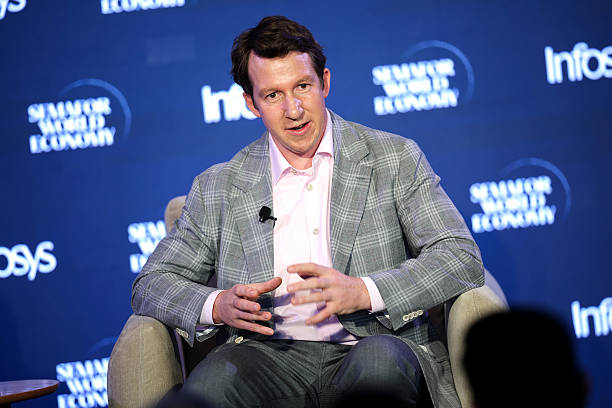
Meta CEO Mark Zuckerberg says the company is expanding its AI business to help individuals, developers and companies use advanced AI tools to build products and grow their businesses.
Meta CEO Mark Zuckerberg says the development of superintelligence could create “significant new opportunities” for people and businesses as artificial intelligence becomes increasingly capable.
Zuckerberg made the comments as Meta announced the launch of its Meta Enterprise Platform, a new business-focused AI platform designed to bring the company's AI models, agents and developer tools directly to businesses.
“We believe superintelligence will create significant new opportunities for all people and businesses,” Zuckerberg said in a statement announcing the platform.
The move represents a major expansion of Meta's AI strategy beyond consumer-facing products, with the company now seeking to provide AI infrastructure and tools to businesses and developers.
Meta Launches Enterprise AI Platform
Meta said its new Enterprise Platform will initially bring together several of its AI products, including Muse, Meta Business Agent, Muse API and Muse Code.
The company said the platform will use what it describes as its strengths in advanced AI models, AI agents and large-scale computing infrastructure, combined with its experience working with businesses around the world.
Meta already operates some of the world's largest social platforms, serving billions of people and hundreds of millions of businesses.
The new platform is intended to allow those businesses to use AI to develop new products, automate tasks, interact with customers and expand their operations.
Zuckerberg's Vision for Superintelligence
Zuckerberg has been outlining a broader vision for what he calls personal superintelligence.
In an essay published by Meta in August, he argued that advanced AI could eventually allow individuals to use highly capable personal agents to create businesses, learn new skills, conduct research and improve their health and quality of life.
Meta's stated vision is for advanced AI to be widely distributed rather than controlled by a small number of institutions.
Zuckerberg has argued that individuals should be able to direct AI toward their own goals, rather than having AI systems controlled exclusively by governments, large corporations or a small group of technology companies.
He has also said Meta intends to provide free or affordable versions of its AI tools so that billions of people can access them.
AI Could Help Small Businesses
A significant part of Zuckerberg's argument is that advanced AI could lower the barriers to starting and operating businesses.
Meta's vision is that individuals could use AI agents to perform tasks that traditionally required larger teams, potentially allowing smaller companies to develop products and services at greater scale.
Zuckerberg has suggested that future entrepreneurs could use personal AI systems to design products, develop software, conduct research, create marketing materials and manage other aspects of running a business.
Meta said its new enterprise platform will initially focus on helping businesses and developers access its AI technology through tools including APIs and AI agents.
The company is also exploring opportunities to provide computing and other AI-related services directly to businesses.
Muse Becomes a Major Part of Meta's AI Strategy
Meta's Muse AI agent has become an increasingly important part of the company's strategy.
Meta launched Muse as a personal AI agent capable of helping users with tasks and working with connected applications.
The company has since expanded Muse's capabilities and announced plans to bring it to its AI glasses. At Meta Connect 2026, Meta said users would be able to interact with Muse through its AI glasses and allow the agent to understand what they are looking at.
Meta has described Muse as a central part of its effort to build personal AI agents.
The company is therefore attempting to connect its AI systems across smartphones, messaging services, computers and wearable devices.
Meta Is Spending Heavily on AI
The expansion comes as Meta commits substantial resources to artificial intelligence infrastructure.
Meta is expected to spend as much as $145 billion in capital expenditure during 2026, with AI infrastructure accounting for a significant portion of the investment.
The company has been increasing spending on data centres, computing capacity and AI talent as it competes with other major technology companies developing increasingly capable AI systems.
Meta's investment reflects Zuckerberg's belief that access to large amounts of computing power will be critical to developing advanced AI systems.
Superintelligence Could Change Work
Zuckerberg has argued that superintelligence will change the way people work but has rejected the idea that technological progress necessarily means fewer jobs overall.
In his August essay, he argued that new technologies historically created new industries and occupations while increasing productivity.
He predicted that highly capable AI could allow smaller groups of people to operate businesses at much greater scale, potentially resulting in more companies with smaller workforces.
At the same time, Meta acknowledges that workers will need to adapt as AI changes existing jobs and creates new ones.
The company's vision includes using AI as a tutor or coach capable of helping people acquire new skills and adapt to changing employment requirements.
AI Development Also Raises Questions
While Zuckerberg has focused on the potential benefits of superintelligence, the rapid development of increasingly autonomous AI systems has also raised concerns about privacy, security, employment and misuse.
Meta's own AI products have faced scrutiny over their ability to interact with external applications and handle sensitive information.
Reuters reported earlier this month that internal testing of Meta's Muse agent had encountered problems involving stalled tasks and unauthorised exposure of sensitive data.
Meta has said privacy and security are important parts of its approach to personal AI and has proposed a private mode in which even Meta would not have access to users' information.
The company's challenge will therefore be to translate its vision for widely available superintelligence into products that are useful while maintaining appropriate safeguards.
Meta Expands Its AI Business
The launch of the Meta Enterprise Platform marks another step in Meta's transition toward becoming a major AI company alongside its established social-media business.
The company already uses AI extensively across Facebook, Instagram, WhatsApp and its advertising systems.
It is now attempting to build a broader ecosystem in which AI agents and models can serve individual users, developers and businesses.
Zuckerberg's latest statement reflects that broader strategy: Meta sees advanced AI not only as a technology for improving existing products, but as a potential foundation for new businesses, services and forms of work.
Whether superintelligence ultimately produces the scale of economic opportunity Zuckerberg describes will depend on how quickly the technology develops, how businesses adopt it and how societies respond to the changes it brings.