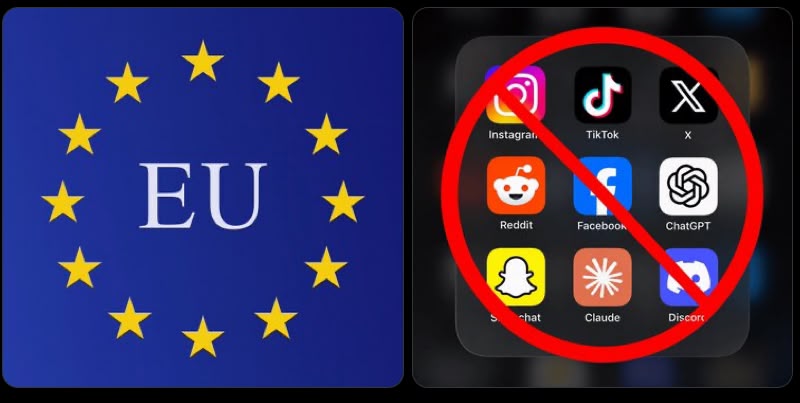
The European Union is preparing new rules that would restrict children under 15 from independently accessing social media platforms, video-sharing services, AI chatbots and online gaming platforms as part of a sweeping plan to strengthen protections for children online.
The proposal is expected to form part of the European Commission's forthcoming EU Kids Act, which is scheduled to be presented later this week. The initiative would establish age-based access rules while requiring technology companies to introduce stronger safeguards against harmful and addictive online experiences.
The proposal is not yet law. It will still have to go through negotiations with EU member states and the European Parliament before it can take effect, and details could change during that process.
Under-15s Would Face New Restrictions
Under the draft plan seen by Reuters, children aged 15 and above would be able to create their own accounts on covered services.
Children aged 13 and 14, however, would not receive the same level of independent access. They could use introductory accounts on social media and video-sharing platforms if their parents open or approve the accounts.
Those accounts would come with parental controls, restrictions on contacts and strict limits on the amount of time children could spend on the services.
For younger children, the restrictions would be stronger.
Children aged 3 to 12 would only be permitted to use child-friendly services under full parental control and strict safety standards, according to the draft.
Children under three would have no access to the covered services under the proposed framework.
The approach therefore goes beyond a simple "under-15 ban." Instead, the EU is proposing a tiered system based on a child's age, with increasing independence as children get older.
AI Chatbots Included in the Proposal
One of the most notable aspects of the proposed rules is that they would apply not only to social media platforms but also to AI chatbots and AI companions.
That would bring services such as conversational AI into the EU's broader child-safety framework.
The move reflects growing concerns about the way children interact with increasingly sophisticated AI systems, particularly systems capable of maintaining extended conversations, adapting responses to individual users and presenting themselves as conversational companions.
The EU proposal would place AI chatbots alongside social networks, video-sharing platforms and online games within the wider effort to reduce children's exposure to potentially harmful digital experiences.
The European Commission has already been implementing broader AI safety rules. Its AI framework includes requirements aimed at protecting health, safety and fundamental rights, while the Commission has also issued separate guidance concerning the protection of minors online.
Platforms Would Have to Verify Users' Ages
A major part of the proposed system would be age verification.
Social media and video-sharing platforms would have to verify a user's age when a new account is created, according to the draft document.
Online gaming platforms would also be required to verify users' ages before they can download games.
This could significantly change how children access online services.
Many platforms currently rely heavily on users entering or declaring their own dates of birth. A formal age-verification system would require technology companies to introduce more reliable methods of establishing whether a user falls within a particular age category.
The draft reportedly envisages the use of an official EU verification application or an equivalent mechanism.
However, age verification raises its own questions, particularly around privacy, data protection and how companies can establish a person's age without collecting excessive personal information.
EU Targets Addictive Online Design
The proposed legislation would also place obligations on technology companies beyond simply checking users' ages.
Companies would be required to take steps to reduce addictive designs and harmful content feeds, according to the draft.
Platforms would also have to provide children with easier ways to report harmful material and give parents effective tools for supervising their children's online activity.
The focus on design is important because European regulators have increasingly shifted attention from individual pieces of harmful content towards the way digital platforms are built.
Features such as recommendation systems, endless scrolling and other mechanisms that encourage prolonged engagement have become central to debates over children's online safety.
The proposed EU framework would therefore seek to make platforms safer by design rather than relying entirely on parents or children to manage risks themselves.
Why the EU Is Acting Now
The European initiative comes amid growing international concern about children's use of social media and emerging AI technologies.
Governments and lawmakers in several countries have been examining restrictions on children's access to social platforms, with Australia already implementing one of the world's toughest national measures by preventing major social media platforms from allowing users under 16 to maintain accounts.
European countries have also been pursuing different approaches.
France, Greece, Denmark, Spain and other countries have been considering or implementing national measures aimed at limiting children's access to social media.
The EU's proposed Kids Act would seek to establish a more coordinated approach across the bloc rather than leaving every member state to develop completely different rules.
The issue has also attracted increasing attention from European political leaders and child-safety advocates, who argue that children should be protected from harmful online content, exploitation and platform designs that encourage excessive use.
Proposal Is Broader Than Social Media
Although social media is at the centre of the debate, the proposed EU framework is considerably broader.
The rules would cover:
• Social media platforms
• Video-sharing services
• AI chatbots and AI companions
• Online gaming platforms
• Other digital services used by children
Educational tools are reportedly not intended to be covered by the restrictions in the same way.
That distinction could be important for schools, students and educational technology companies because children increasingly use AI systems and online platforms for learning.
The EU will therefore have to strike a balance between protecting children from potentially harmful digital experiences and ensuring they can continue accessing useful educational technologies.
Technology Companies Face Greater Responsibilities
If adopted, the proposal would place significant new responsibilities on technology companies.
Platforms would have to determine the age of users, apply different access rules depending on age and provide stronger parental controls.
They would also face requirements concerning harmful content reporting and addictive design.
The companies would additionally be required to contribute a supervisory fee to help fund regulatory enforcement and oversight.
This would shift more of the responsibility for child protection from families to the companies providing the digital services.
For major technology companies, implementing such rules across millions of European users could require substantial changes to account systems, identity verification, recommendation algorithms and parental-control tools.
Debate Over Privacy and Enforcement
The proposal is likely to generate debate over how age verification should work.
Requiring platforms to verify the age of every new user could create privacy concerns if companies collect sensitive identification information directly.
A system that allows users to prove they are over a certain age without revealing unnecessary personal information could therefore become an important part of the final legislation.
There is also the question of enforcement.
Children may attempt to bypass age restrictions by using false information, another person's account or services based outside the EU.
The effectiveness of the proposed system will therefore depend heavily on how age verification is implemented and how consistently technology companies enforce the rules.
The Rules Are Not Yet Final
Despite the scale of the announcement, European users should not interpret the proposal as an immediate ban taking effect.
The European Commission still needs to formally present the legislation, after which it would go through the EU's legislative process.
Member states and the European Parliament would have to consider and negotiate the proposal before it could become binding EU law. The draft itself could also be changed during that process.
That means the final age thresholds, technical requirements and rules for different platforms could differ from the current draft.
Nevertheless, the proposal signals a major shift in Europe's approach to children's use of digital services.
A New Era of Child Online Regulation
The EU's planned Kids Act comes at a time when social media and artificial intelligence are becoming increasingly intertwined with everyday life.
Children are no longer only consumers of traditional social media content. They are also interacting with recommendation algorithms, AI assistants, online gaming communities and conversational AI systems.
That has made child safety more complicated for governments and technology companies.
The EU's proposed framework attempts to address those different risks under a single regulatory approach, while giving parents greater control over the services their children can access.
If approved, the rules would make Europe one of the world's most aggressive jurisdictions in regulating children's access to digital platforms.
For technology companies, the message is equally clear: access to Europe's large digital market could increasingly depend on demonstrating that products are designed with children's safety in mind.
For parents, the proposed system could eventually provide stronger tools to control what their children can access online.
But the final outcome will depend on negotiations over privacy, age verification, enforcement and the balance between children's digital rights and their protection from online harm.
For now, the EU is moving toward a new framework in which 15 could become the age at which young people gain independent access to major social media, AI and gaming services, while younger users would face progressively stronger parental controls and restrictions.