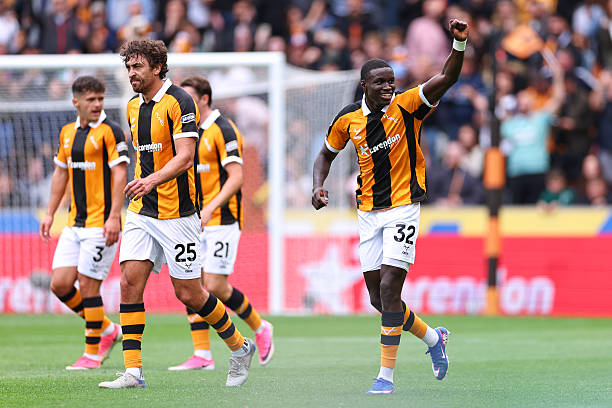
An astonishing opening weekend encounter that reverberate throughout English football, newly promoted Hull City marked their return to the Premier League with a monumental 2-0 victory over Manchester United. Playing in their first top-flight fixture since 2017, the Tigers delivered a tactically disciplined and courageously aggressive performance at the KCOM Stadium to record their first league victory over the Red Devils in 52 years, ending a agonizing drought that stretched back to 1974.
The victory produced an indelible moment for Hull City’s newly appointed manager, Sergej Jakirović, who made history on the day by becoming the first Bosnian ever to manage in the Premier League. Conversely, for Manchester United head coach Michael Carrick, the result delivered a sobering reality check. The defeat marked the first time since 1973 that Manchester United have lost their opening match of a Premier League campaign in back-to-back seasons, exposing persistent tactical vulnerabilities and raising immediate questions about their top-four aspirations.
First-Half Blitz: How Hull City Stunned the Red Devils
Despite entering the contest as heavy underdogs, Hull City matched Manchester United’s intensity from the opening whistle. Following early exchanges where Tigers goalkeeper Konstantinos Tzolakis produced fine saves to deny new United signings Bryan Mbeumo and Matheus Cunha, the hosts seized momentum through set-piece dominance. Energetic forward Oli McBurnie forced a sharp save from United goalkeeper Senne Lammens with a towering header, before wing-back Ryan Giles saw a powerful drive tipped over the crossbar. From the resulting corner kick, McBurnie’s powerful header was tipped onto the post by Lammens, only for defender Semi Ajayi to react fastest, smashing home the rebound from close range to trigger rapturous home celebrations.
Stung by the opening goal, Manchester United sought an immediate response. Midfielder Patrick Dorgu squandered two promising opportunities after being picked out by precise passes from Bruno Fernandes and Harry Maguire, firing off-target on both occasions. Mbeumo then saw an acrobatic volley deflected behind by debutant defender Nobel Mendy, who would make a decisive impact at the opposite end moments later. Meeting Regan Slater’s pinpoint free-kick delivery with clinical timing, Mendy guided a brilliant header past Lammens to double the hosts' advantage. A crucial late block by experienced defender John Egan to deny Fernandes ensured Hull City entered the half-time break with a thoroughly deserved two-goal cushion.
Resilient Defending and Tactical Mastery Seal the Victory
Recognizing the urgent need for tactical adjustment, Michael Carrick introduced forward Marcus Rashford in place of Dorgu at the start of the second half. However, Manchester United’s revamped attack continued to struggle against Hull City’s compact defensive block. Young defender Ayden Heaven failed to direct a header on target, while Mbeumo saw a low strike well saved by Tzolakis during a rare moment of central penetration.
Exuding immense confidence, Hull City continued to offer a dangerous threat on the counter-attack, highlighted by a mazy run from McBurnie and a long-range strike from Mohamed Belloumi that narrowly cleared the crossbar. Even after sustaining disruptive double injury blows—with key debutant Mendy and club captain Lewie Coyle forced off within a seven-minute span—Jakirović’s side refused to falter. Replacement Cody Drameh came close to adding a third goal late on, while Tzolakis comfortably dealt with a speculative late effort from Maguire. When the final whistle blew, Hull City secured three remarkable points, delivering an emphatic opening statement to the rest of the division.
Defensive Low Blocks and Second-Ball Domain Dynamics
To understand how a newly promoted side systematically disrupted a top-four contender, one must analyze the tactical principles of compact low-block structures and second-ball domain dominance in modern transition play. Facing a team with superior individual technical quality, Sergej Jakirović organized Hull City into a compact, low-defensive block, intentionally surrendering non-threatening possession in wide areas while drastically compressing space between their defensive line and central midfield zone.
By denying space in behind for runners like Mbeumo and Rashford, Hull City forced Manchester United into slow, U-shaped circulation around their defensive perimeter. Furthermore, the hosts dominated second-ball domain dynamics—the critical split-second phase immediately following aerial duels or set-piece deliveries. By positioning players like Semi Ajayi and Regan Slater around physical focal points like McBurnie, Hull City repeatedly won contested second balls inside both penalty boxes, neutralizing United's positional structure and generating direct, high-value goalscoring opportunities.
From Top-Flight Absence to Historic Breakthrough
Hull City’s return to the Premier League represents the culmination of a patient, multi-year rebuilding process following their relegation from the top flight at the conclusion of the 2016–17 campaign. Spending nearly a decade navigating the grueling competitive landscape of the EFL Championship, the Yorkshire club underwent significant ownership restructuring and tactical retooling to establish sustainable football operations.
Their historical record against Manchester United added further weight to Saturday's achievement. Prior to this encounter, Hull City had failed to record a league victory over the 20-time English champions since a historic victory in November 1974. Over the intervening five decades, meetings between the two clubs were almost exclusively dominated by Manchester United. Breaking that 52-year league drought on the opening day of their return campaign stands as one of the most remarkable results in Hull City's modern history.
Strategic and Economic Impact Across the Premier League
The immediate implications of this result extend far beyond a single matchday outcome, impacting both clubs' seasonal trajectories and structural expectations:
-
Top-Flight Survival Economics: For newly promoted clubs, securing early victory momentum is statistically vital for Premier League survival. Beating a top-six opponent on opening day provides Hull City with immediate belief, vital points in the relegation fight, and substantial momentum in a season where top-flight financial distribution exceeds £100 million in broadcast revenue.
-
Pressure Mounting on Carrick: For Manchester United, dropping three points against a newly promoted side intensifies media scrutiny surrounding Michael Carrick’s tactical framework. After ending the previous season with structural inconsistencies and experiencing consecutive opening-day defeats for the first time in 53 years, United's coaching staff faces immediate pressure to integrate new signings and stabilize their defensive shape.
-
Tactical Blueprint for Promoted Clubs: Hull City’s performance offers a clear structural blueprint for newly promoted entities competing against elite opposition, proving that rigorous physical preparation, set-piece precision, and structured spatial compression can bridge vast financial disparities.
Balkan Managerial Representation and Global Reach
Sergej Jakirović’s historic debut as the first Bosnian manager in Premier League history represents a significant milestone for South-Eastern European football coaching. Having built a strong reputation across regional European competitions, Jakirović’s immediate tactical success on English football's global stage highlights the expanding diversity and global reach of modern Premier League management.
For Manchester United, whose global fanbase spans hundreds of millions across international markets, an opening-day defeat creates widespread media focus across global sports networks. As the Premier League season unfolds, all eyes will remain on how Carrick recalibrates his squad to salvage their campaign, while Hull City look to transform their historic opening triumph into long-term top-flight sustainability.