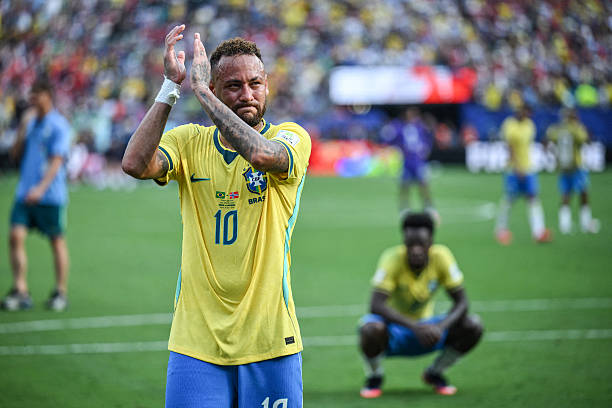
SANTOS — In a historic moment that marks the conclusion of one of the most brilliant yet fiercely debated careers in international sports history, Brazilian icon Neymar da Silva Santos Júnior has officially retired from international football.
The 34-year-old forward confirmed the definitive end of his 16-year journey with the Brazilian national team following a 4-2 victory for Santos against Universidad Central in the second leg of the Copa Sudamericana knockout round playoffs. The announcement brings a definitive close to months of global speculation regarding his future with the five-time world champions following Brazil’s unexpected elimination from the 2026 FIFA World Cup in North America.
Speaking candidly to reporters in the post-match mix zone, the former Barcelona and Paris Saint-Germain star reflected on his legacy, expressing emotional exhaustion and a sense of completion after carrying the weight of a football-obsessed nation for nearly two decades.
"My time with the national team is over," Neymar stated. "I made history, I was very happy, I gave my blood, my life. I always fought for the yellow jersey, but now I don’t want to anymore."
The Final Curtain: From World Cup Heartbreak in North America to Santos Victory
Neymar’s final official appearance in the iconic yellow jersey of the Seleção occurred during a turbulent Round of 16 clash against Norway at the 2026 FIFA World Cup.
Despite entering the tournament plagued by physical setbacks, the veteran forward converted a high-pressure penalty deep into stoppage time. However, the late strike proved to be a mere consolation as Norway secured a 2-1 victory, eliminating Brazil from the tournament and crushing the country's dream of securing an elusive sixth star.
The journey to that final international goal was defined by resilience against severe physical adversity. A grade two calf muscle injury sustained while competing for his boyhood club Santos severely disrupted his pre-tournament preparation, ruling him out of Brazil’s opening group-stage fixtures against West African powerhouses and European opposition.
He managed to return to match action as a late substitute in Brazil’s final group fixture against Scotland before making another bench appearance against Norway, where he netted the 80th and final goal of his storied international career.
Upon returning to domestic duty with Santos in Brazil, media speculation mounted regarding whether the playmaker would consider one final campaign leading into the 2028 Copa América. However, his unequivocal post-match statements in Santos confirmed that his international chapter has reached its absolute end.
Record-Breaking Legacy: Surpassing Pelé and Redefining Modern Brazilian Football
Neymar leaves the international arena as the most prolific goalscorer in the history of Brazilian men’s football, having amassed an extraordinary 80 goals across 128 senior appearances for his country.
By reaching the 80-goal milestone, he officially surpassed the legendary Pelé, who had held the national scoring record of 77 goals for more than half a century. Neymar’s international journey began in August 2010, when he scored on his senior debut against the United States at just 18 years old, immediately inheriting the mantle of Brazilian football's next savior.
Throughout his 16-year tenure, Neymar delivered landmark moments that etched his name into the annals of South American sporting history. He was the undisputed star of the 2013 FIFA Confederations Cup, claiming the Golden Ball as Brazil swept past reigning European and World champions Spain in the final at the Maracanã.
Three years later, during the 2016 Rio Olympic Games, Neymar captained the national Olympic squad to its first-ever gold medal in men's football, scoring a sensational free-kick in the final against Germany before converting the winning penalty in a dramatic shootout to exorcise historical ghosts.
Despite participating in four FIFA World Cups 2014 in Brazil, 2018 in Russia, 2022 in Qatar, and 2026 in North America world championship glory ultimately eluded him. His 2014 campaign famously ended in tragedy when a severe back injury sustained in the quarter-final against Colombia sidelined him before Brazil's devastating semi-final defeat. Nevertheless, his raw individual brilliant performances across multiple Copa América tournaments and global qualifiers established him as the benchmark of technical excellence for an entire generation.
Expert Breakdown: Physical Demands, Chronic Injuries, and the Biomechanics of Playmaking
To fully comprehend the timing of Neymar’s international retirement, it is essential to examine the physiological demands placed on elite attacking playmakers within modern, high-intensity international tactical systems.
Throughout his peak years, Neymar operated as an inverted winger and primary central playmaker, relying heavily on explosive deceleration, sharp directional shifts, and rapid acceleration to bypass low-block defenses. This style of play made him the most fouled player across Europe's top leagues and international tournaments for over a decade, resulting in severe recurrent trauma to his ankle ligaments and foot structure.
Sports medicine specialists emphasize that grade two calf muscle tears, such as the injury Neymar suffered ahead of the 2026 World Cup, involve partial tearing of muscle fibers, requiring extensive rehabilitation to restore muscular power and kinetic chain stability.
For an athlete in his mid-30s who has previously undergone complex ankle reconstruction surgeries, the physical strain of maintaining peak conditioning for both high-stakes club competitions and international matches becomes unsustainable. The intense pressing structures and physical transitions characteristic of modern international football drastically reduce the operational lifespan of traditional dribblers, making his decision to step away a calculated preservation of his remaining club career with Santos.
Why It Matters: The Socio-Economic and Cultural Impact on Brazilian Sport
Neymar’s departure from international football carries profound economic, cultural, and structural implications for the Brazilian Football Confederation (CBF) and the broader global sports marketing ecosystem.
For nearly two decades, Neymar served as the undisputed commercial engine of Brazilian sports. His presence on the pitch guaranteed premium broadcasting rights fees, multi-million-dollar international friendly match guarantees, and lucrative global corporate sponsorships. His personal brand appeal bridged the gap between traditional football audiences and digital-native youth demographics across South America, Asia, and North America.
From a cultural perspective, Neymar represented the last direct link to the classical "Joga Bonito" era—a style defined by individual flair, street-football improvisation, and uninhibited creative expression.
His retirement forces a structural shift in how Brazilian football marketability is structured. Moving forward, corporate sponsors and broadcasting networks will need to diversify their commercial strategies, spreading marketing investments across a collective group of young stars rather than relying on a single, dominant global megastar to anchor national team campaigns.
Regional and Global Context: Rebuilding the Seleção for a New Era
Neymar’s international retirement coincides with a transformative period for South American football as national teams calibrate their rosters ahead of the 2028 Copa América and the 2030 FIFA World Cup cycle.
The departure of their iconic captain officially completes a generational transition for Brazil, thrusting a new core of elite young talent into primary leadership roles. World-class attackers such as Vinícius Júnior, Rodrygo, and Endrick must now inherit the creative and tactical responsibilities previously carried almost exclusively by Neymar.
Across South America, the conclusion of Neymar’s international career mirrors the broader twilight of a golden era of iconic South American superstars who defined global football throughout the 2010s and 2020s.
As the Brazilian Football Confederation initiates a comprehensive review of its national team structures following the 2026 World Cup disappointment, Neymar’s retirement serves as a definitive turning point. The Seleção now faces the imperative task of forging a modern, collective tactical identity capable of reclaiming continental dominance and returning world championship glory to Brazil without the safety net of their modern legend.