Nigeria’s high-net-worth population has recorded its first annual expansion in five years, driven by a strengthening naira,robust capital market gains, and expanding enterprise creation across West Africa. According to newly released data from the 2026 Africa Wealth Report published by global wealth intelligence firm New World Wealth, the number of High-Net-Worth Individuals (HNWIs) in Nigeria—defined as individuals holding more than $1 million in liquid wealth—rose by 12.5 percent over a twelve-month period. The country's dollar-millionaire count reached 8,100 in June 2026, up from 7,200 recorded in mid-2025.
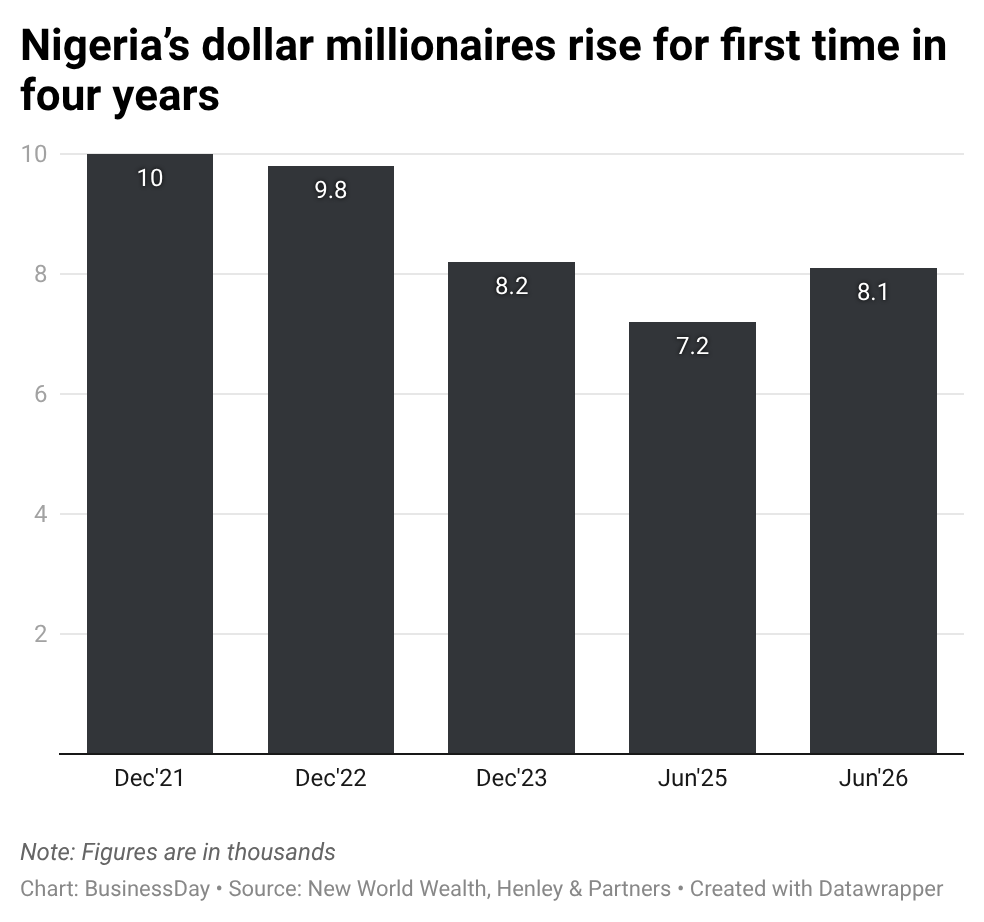
This positive pivot follows an extended period of severe wealth contraction caused by foreign exchange volatility and steep currency devaluations. The addition of 900 dollar millionaires signals a meaningful, albeit partial, recovery from the severe erosion experienced in preceding years, when the country lost an estimated 1,600 millionaires in 2024 and 200 in 2023. While the long-term trajectory still reflects a multi-year decline relative to historical peak levels, the latest figures suggest that comprehensive macroeconomic stabilization policies, capital market performance, and resilient corporate earnings are fostering a more favorable domestic environment for private capital generation.
Mechanics of Wealth Creation: Currency Valuation, Asset Prices, and New Enterprise
To understand how Nigeria added 900 dollar millionaires in a single year, one must examine the dual engines driving the increase: foreign exchange appreciation and capital market expansion. The head of research at New World Wealth,Andrew Amoils, confirmed that the primary catalyst behind the 12.5 percent rise was the structural recovery of the Nigerian naira against the United States dollar, combined with steady expansion in new business formation.
In private wealth accounting, High-Net-Worth Individuals (HNWIs) are categorized based on liquid wealth, which includes convertible financial assets, cash holdings, public equity shares, and liquid private holdings, while excluding primary residential real estate. Because HNWI metrics are standardized globally in U.S. dollars, domestic currency fluctuations exert a powerful structural effect on national wealth totals. When the naira appreciates against the dollar, the dollar-equivalent value of naira-denominated assets automatically expands. Consequently, individuals whose liquid portfolios were previously valued just below the $1 million threshold are lifted into the dollar-millionaire classification without requiring a proportional increase in nominal domestic asset prices.
Simultaneously, the Nigerian Exchange Group (NGX) experienced a prolonged bull run following structural economic reforms initiated under President Bola Tinubu’s administration. Group Managing Director and Chief Executive Officer of the NGX, Temi Popoola, recently highlighted that capital market appreciation generated between 500,000 and 900,000 new naira-denominated millionaires since 2023. While naira-denominated gains differ structurally from New World Wealth’s global dollar benchmark, the synchronized rise in both metrics underscores how equity price expansion and public market participation have become central drivers of domestic wealth creation.
Background and Ten-Year Trajectory: Contextualizing Nigeria’s Wealth Erosion
Despite the positive momentum recorded over the past year, the broader ten-year trend highlights the profound impact that currency adjustments and inflation have had on Nigeria's private wealth landscape. Since the initial publication of the Africa Wealth Report in 2013, when Nigeria was home to approximately 15,000 dollar millionaires, the nation's HNWI population has contracted by 46 percent. Over the past decade alone, the country suffered a 33 percent decline in its millionaire population—the steepest overall reduction recorded among Africa’s five largest wealth hubs.
The primary driver of this multi-year contraction was the persistent devaluation of the domestic currency. Major foreign exchange policy overhauls executed in mid-2023 and early 2024 triggered sharp adjustments in the naira's official value as authorities moved toward a unified, market-reflective exchange rate system. These adjustments drastically reduced the dollar valuation of domestic bank deposits, local real estate portfolios, and non-export corporate equity. However,following these initial shocks, the currency stabilized in late 2025 and entered 2026 on significantly stronger footing. By mid-August 2026, the official exchange rate strengthened to approximately N1,364.6 per U.S. dollar, representing a nearly six percent gain year-to-date and ranking the naira among the top-performing currencies on the continent.
Continental Standings: Nigeria Holds Fourth Position in Africa’s Wealth Ranking
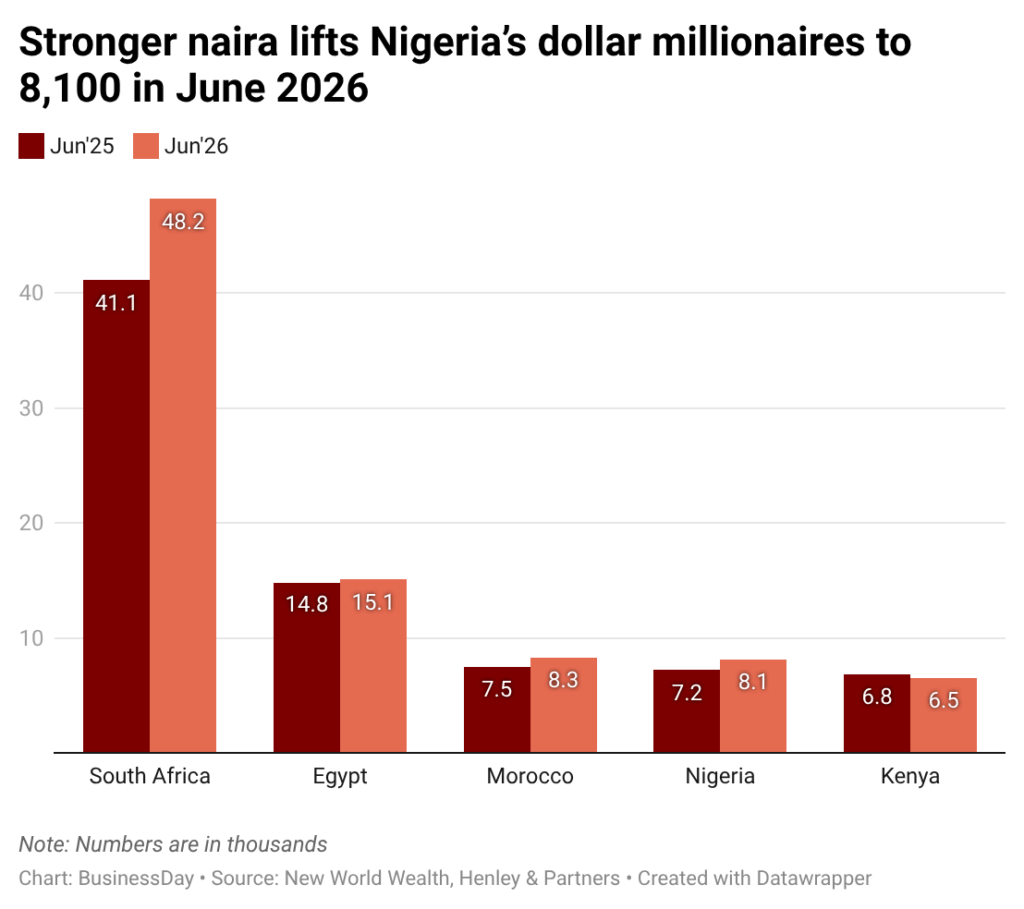
Within the broader continental landscape, Nigeria maintains its position as the fourth-largest wealth market in Africa,trailing South Africa, Egypt, and Morocco, while remaining ahead of fifth-ranked Kenya. South Africa continues to lead the continent by a wide margin with 48,200 dollar millionaires, registering a 17.3 percent increase over the past year.Egypt occupies second place with 15,100 millionaires, followed by Morocco with 8,300, Nigeria with 8,100, and Kenya with 6,500.
+---------------+------------------------+-------------------+--------------------+
| Country       | Dollar Millionaires    | Annual Growth (%) | 10-Year Growth (%) |
|               | (June 2026)            |                   |                    |
+---------------+------------------------+-------------------+--------------------+
| South Africa  | 48,200                 | +17.3%            | Moderate Growth    |
| Egypt         | 15,100                 | +2.0%             | Stable             |
| Morocco       | 8,300                  | +10.7%            | +55.0%             |
| Nigeria       | 8,100                  | +12.5%            | -33.0%             |
| Kenya         | 6,500                  | -4.4%             | Contraction        |
+---------------+------------------------+-------------------+--------------------+
Morocco recorded the most resilient ten-year performance among Africa's primary wealth centers, expanding its HNWI population by 55 percent over the decade. Wealth analysts attribute Morocco’s sustained growth to significant inflows of high-net-worth retirees from Europe and the Middle East, a stable currency environment, and strong capital appreciation across prime real estate markets in Marrakech and Tangier. Smaller niche jurisdictions, such as Mauritius and Rwanda,recorded even higher percentage growth rates over the same period, driven by favorable tax structures, streamlined business regulations, and targeted investor visa programs.
The 2026 report also highlights that Nigeria’s ultra-wealthy tier experienced modest gains. The nation now counts 22 centi-millionaires—individuals holding over $100 million in liquid assets—up from 20 in the previous reporting cycle.Meanwhile, Nigeria's total dollar-billionaire count remained unchanged at three. Across the entire African continent,private wealth totals surpassed 127,000 dollar millionaires, including 374 centi-millionaires and 28 dollar billionaires.
Macroeconomic Alignment: GDP Acceleration and Foreign Exchange Stability
The resurgence in private wealth coincides with a broader macroeconomic recovery reflected in official statistical releases. Data from Nigeria’s National Bureau of Statistics (NBS) indicates that real Gross Domestic Product (GDP) grew by 3.87 percent in 2025, accelerating from 3.38 percent in 2024. Economic momentum gathered further pace in the final quarter of last year, when growth touched 4.07 percent.
This upward momentum carried into early 2026, with first-quarter real GDP expanding by 3.89 percent—the fastest Q1 growth rate recorded by the West African nation in over a decade. Improved foreign exchange liquidity, rising external reserves managed by the Central Bank of Nigeria, and sustained non-oil sector output have created a supportive environment for private enterprise. Stronger corporate earnings across the banking, industrial manufacturing,telecommunications, and consumer goods sectors have translated into higher dividend yields and equity valuations,reinforcing the balance sheets of institutional and private investors alike.
Regional Trends and Emerging Wealth Hubs: The Rise of Lifestyle Jurisdictions
Beyond traditional economic centers, wealth intelligence trends point toward a notable shift in how private capital moves across Africa. High-net-worth individuals are increasingly relocating capital and primary residences to specialized "lifestyle destinations" that offer a combination of tax efficiency, personal security, high-grade healthcare, and environmental amenities. Cities and regions experiencing accelerated HNWI migration include Cape Town, Marrakech,Swakopmund, the Cape Winelands, and Windhoek.
Namibia has emerged as a premier growth market for private wealth destination planning within Southern Africa. The country offers a highly favorable fiscal framework, featuring no capital gains tax, no estate duties, and no tax on foreign-sourced income. This tax environment places Namibia alongside premier global financial hubs such as Singapore,Monaco, the United Arab Emirates, and the Cayman Islands. Coupled with sophisticated banking systems, established eco-tourism conservation zones, and new luxury residential developments, Namibia is positioning itself as a primary destination for foreign direct investment and high-net-worth migration across the Sub-Saharan region.
Future Outlook: Rebuilding Sustainable Private Wealth in West Africa
While the addition of 900 dollar millionaires represents a clear structural rebound for Nigeria, wealth managers and economic policy analysts emphasize that sustained recovery will depend on long-term policy consistency. Rebuilding national private wealth back to historical peak levels will require durable currency stability, moderate inflation rates, and continued capital market deepening.
As Nigeria continues to navigate its ongoing structural reforms, the expansion of its HNWI baseline offers a positive signal to regional and international investors. The stabilization of the foreign exchange market, combined with expanding corporate profit margins and new enterprise creation, suggests that West Africa's largest economic market is establishing a firmer foundation for long-term private capital accumulation.