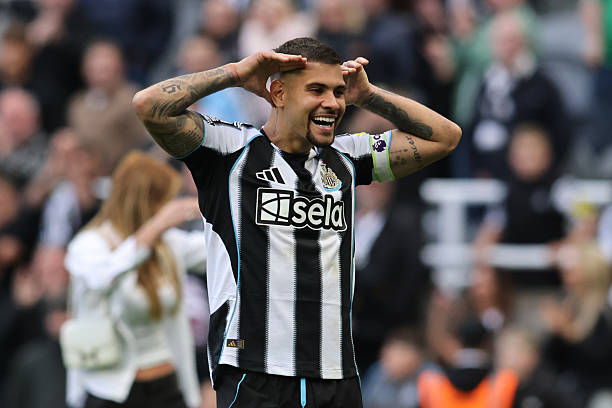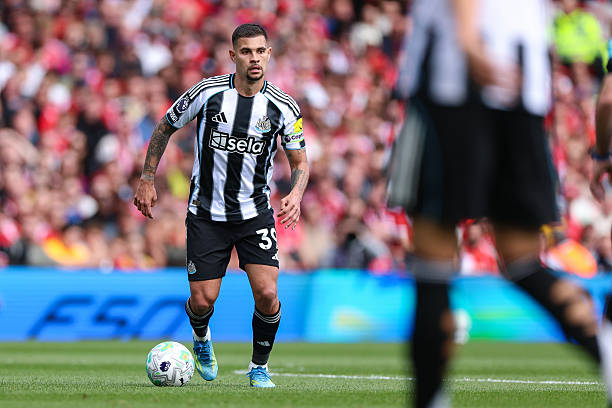
LONDON — Newcastle United has officially agreed to sanction the sale of club captain and Brazil international midfielder Bruno Guimarães to reigning Premier League champions Arsenal for a fixed compromised fee of £75 million.
The high-stakes transaction brings an end to weeks of intense structural negotiations between the two clubs. Arsenal initially opened talks with a verbal proposal valued below £60 million, while Newcastle executives stood firm on a significantly higher valuation to protect their star asset.

However, a decisive financial compromise was reached to grant the twenty-eight-year-old midfielder his explicit desire to complete a move to North London.
The agreed £75 million baseline figure represents a clean, upfront structural package without conditional performance add-ons, clearing the path for the player to leave Newcastle’s pre-season training camp in Spain to undergo formal medical assessments ahead of signing his long-term contract at the Emirates Stadium.
Negotiation Mechanics and Financial Distribution: The Lyon Sell-On Clause
The structural details of the transfer agreement reveal how both clubs navigated contract timelines, release clause expirations, and third-party financial obligations to finalize the deal.
Guimarães had entered the final two years of the five-year contract extension he signed with Newcastle in October 2023. That agreement famously contained a temporary £100 million release clause, but the buy-out mechanism officially expired in late June 2024 without being triggered by interested suitors.
When Guimarães formally notified Newcastle leadership in early July of his intention to seek a fresh challenge at Arsenal, the Tyneside club was forced to balance its desire to retain its key leader against the strategic risk of a depreciating transfer asset.
A critical economic component of the transaction involves French club Olympique Lyonnais. When Newcastle acquired Guimarães from Lyon in January 2022 for an all-inclusive fee of €50 million, the contract included a mandatory twenty percent profit-share sell-on clause.
Because Newcastle purchased the player for roughly £40 million baseline equity and is selling him for £75 million, the resulting net profit yields a mandatory windfall of between £6 million and £7 million for Lyon, reducing Newcastle's net capital retention from the £75 million transfer.
Tactical Analysis: What Bruno Guimarães Brings to Mikel Arteta’s Arsenal
From a tactical standpoint, acquiring Bruno Guimarães represents a major structural upgrade for Arsenal’s central midfield, adding world-class press resistance, technical leadership, and elite ball-progression dynamics to the reigning champions.
The Brazilian international operates as a premier deep-lying playmaker capable of dictating match tempo while insulating defensive lines. During the most recent domestic campaign, Guimarães ranked among the elite midfielders in European football for ball bravery in tight central areas, averaging twelve completed passes per ninety minutes while under intense physical pressure from opposing defenders.
His spatial awareness allows him to absorb pressure, turn out of tight markers, and open up passing lanes against low-block defensive structures.
Furthermore, Guimarães provided unmatched vertical ball progression for Newcastle, completing 16.2 line-breaking passes per ninety minutes—the highest rate of any player in Eddie Howe’s squad, with the remaining top four positions occupied exclusively by central defenders operating with far more open pitch space.
In addition to his technical distribution, Guimarães brings immense physical durability and proven goal contribution, having recorded nine goals and eight assists across forty-one appearances last season, alongside delivering four assists in five starting appearances for Brazil at the 2026 FIFA World Cup.
Line-Breaking Metrics, Sell-On Equity, and Profitability and Sustainability Rules
To fully appreciate the strategic magnitude of this transfer, it is necessary to examine the technical scouting metrics and financial regulatory mechanics governing modern elite football management.
Line-breaking passes represent a critical advanced tracking metric utilized by top-tier analytics departments to measure a player's ability to bypass opposing defensive lines with precise vertical passes.
Rather than accumulating safe horizontal or backward passes, a player with high line-breaking volume successfully penetrates opposition midfield banks, instantly advancing their team into high-threat attacking phases.
From a financial regulation perspective, transfers within the English top flight are heavily dictated by the Premier League’s Profitability and Sustainability Rules, alongside UEFA’s Financial Sustainability Regulations.
Sell-on profit clauses mandate that when a player is resold, the percentage owed to the former club is calculated exclusively on the net financial gain above the original purchase cost, rather than the gross transfer total.
For the purchasing club, accounting rules permit the amortization of the £75 million transfer fee evenly over the duration of the player's new contract, allowing Arsenal to spread the annual accounting cost while Newcastle recognizes an immediate, massive capital gain on their balance sheet to offset recent squad reinvestments.
From St. James’ Park Cult Hero to Summer Exodus
The departure of Bruno Guimarães marks the emotional end of a transformative era for Newcastle United following their late 2021 financial takeover.
-
January 2022: Bruno Guimarães signs for Newcastle United from Olympique Lyonnais in a landmark €50 million transaction, instantly becoming the focal point of the club's new era under manager Eddie Howe.
-
October 2023: Guimarães signs a five-year contract extension containing a temporary £100 million release clause valid through June 2024.
-
March 2025: Guimarães captains Newcastle United to victory in the Carabao Cup final, securing the club's first major domestic silverware in decades.
-
June 2026: Guimarães shines on the international stage, starting all five matches for Brazil at the 2026 World Cup and registering four assists.
-
July 2026: Guimarães formally requests a transfer to Arsenal; Newcastle subsequently suffers a broader structural shakeup as manager Eddie Howe departs, replaced by Matthias Jaissle, while high-profile stars Anthony Gordon and Sandro Tonali are sold to Barcelona and Tottenham Hotspur respectively for massive fees.
-
August 2026: Arsenal and Newcastle seal the £75 million compromise agreement, granting Guimarães his desired move to North London.
Squad Transformation at Newcastle and Arsenal’s Title Defense
The economic and operational ramifications of this £75 million transfer extend far across the Premier League landscape, signaling radically different strategic phases for both clubs.
For Arsenal, securing Guimarães establishes an exceptionally dominant, complete midfield system alongside existing core stars. Having clinched the Premier League title, Mikel Arteta’s recruitment strategy focuses on consolidating domestic supremacy and targeting UEFA Champions League victory by signing battle-tested, elite leaders in their physical prime.
Guimarães provides the tactical flexibility to operate either as an elite single pivot or alongside alternative central partners, ensuring Arsenal possesses the deep squad depth required to compete across four front-line competitions.
Conversely, for Newcastle United, the loss of their captain represents a profound structural overhaul during a period of intense institutional transition.
Following the departure of long-serving manager Eddie Howe and incoming head coach Matthias Jaissle taking charge, Newcastle has undergone a radical squad transformation, raising over £250 million through the summer sales of Anthony Gordon to Barcelona for €80 million, Sandro Tonali to Tottenham for £100 million, and now Guimarães to Arsenal.
While these departures create massive short-term tactical voids, they provide Newcastle with immense financial flexibility under Profitability and Sustainability Rules, enabling the club to fund a broad, multi-position rebuild centered around younger international talents like 18-year-old Sean Steur from Ajax and 20-year-old Aladji Bamba from Monaco.
Brazil’s World Cup Stars and the Global Transfer Hierarchy
The transfer of Bruno Guimarães reflects broader global trends governing international player valuations, South American talent pathways, and the financial dominance of English football's elite tier.
Following his standout performances for Brazil at the 2026 FIFA World Cup, Guimarães solidified his reputation as one of the premier central midfielders in global football.
His high-profile move reinforces the continuing trend where top-tier South American international stars utilize established European stepping-stone clubs such as Lyon and Newcastle to build their tactical profiles before securing peak-career moves to traditional European elite contenders.
On the international stage, the transaction underlines the financial concentration within top-flight football, where established champions like Arsenal possess the capital resources to acquire proven, prime-age international captains from direct domestic rivals.
As Guimarães completes his medical and prepares to don the red and white shirt in London, the transfer sets a new benchmark for mid-window Premier League transactions, signaling Arsenal’s unwavering intent to maintain their standing at the summit of modern football.