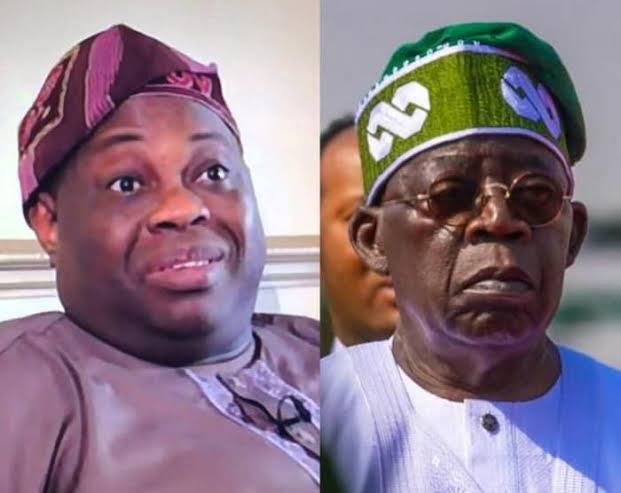
Dele Momodu, a chieftain of the African Democratic Congress (ADC), has criticised President Bola Ahmed Tinubu over his 66th Independence Day address, accusing the administration of worsening Nigeria’s economic and social challenges.
Momodu, who is the Deputy Director-General of Media and Communications of the ADC Presidential Campaign Council, said Tinubu’s nationwide broadcast on Thursday, October 1, turned what should have been a day of celebration into a “day of lamentation.”
His criticism centred on the President’s use of a cancer analogy to explain the economic situation he inherited in 2023 and to defend the reforms introduced by his administration.
Tinubu Describes Nigeria as a Cancer Patient
In his Independence Day address, Tinubu said Nigeria was already facing severe economic problems when his administration took office in 2023.
The President compared the country to a cancer patient who had been using painkillers to manage the symptoms of an underlying illness rather than treating the disease itself.
According to Tinubu, previous administrations had relied on what he described as “morphine” while postponing difficult economic decisions.
“Nigeria was like a sick patient who receives the terrible news that he has cancer,” Tinubu said.
He explained that such a patient could either undergo difficult treatment or continue using morphine to dull the pain while allowing the disease to spread.
“For too long, Nigeria’s leaders chose morphine while praying for a miracle that never came,” the President said.
Tinubu said his administration chose a different approach after assuming office, describing the reforms implemented since 2023 as an attempt to address the underlying problems rather than continue treating their symptoms.
“When this Administration assumed office, we resolved to do things differently. We chose to excise the cancer,” he said.
The President acknowledged that the reforms had produced difficult side effects but argued that the measures were necessary to correct longstanding economic distortions.
Momodu Rejects Tinubu’s Analogy
Reacting to the broadcast, Momodu challenged the President’s description of Nigeria's condition in 2023.
In a post on his verified X account, the former presidential aspirant said he was not impressed by the speech and questioned the appropriateness of comparing Nigeria to a cancer patient.
“My heart bled as you went into the morbid analogy of Nigeria as being a cancer patient that merely survived on pain killers before your arrival as celebrated surgeon,” Momodu wrote.
He argued that Nigeria was not in the advanced condition suggested by Tinubu when the President assumed office.
“At the time you assumed power, Nigeria probably had stage two cancer, at the worst. You were expected to stabilise it and not to metastasize it into a stage four cancer,” Momodu said.
The “stage four cancer” description became the central point of Momodu’s response and was used to accuse the administration of worsening rather than stabilising the country.
Fuel Subsidy Removal Comes Under Attack
Momodu also criticised Tinubu's decision to remove the petrol subsidy shortly after assuming office.
The President announced the end of the petrol subsidy in his inaugural address on May 29, 2023, a decision that was followed by significant changes in fuel prices and broader economic adjustments.
In his response to the Independence Day address, Momodu described the policy as a “misadventure” and argued that the government moved too quickly without adequately assessing the consequences.
“Your first prescription on day one was a monumental disaster. You took no time to properly examine your patient,” he wrote.
Momodu further argued that the policy contributed to severe economic hardship and said the government should have stabilised the country rather than, in his words, destabilising it.
He also said he expected an apology from the administration over what he called the “medical calamity.”
Momodu Lists Nigeria’s Economic Challenges
The ADC chieftain used his response to list several areas where he believes Nigerians are facing difficulties.
He pointed to increased government revenue alongside higher borrowing, rising insecurity and poverty, and what he described as excessive government spending.
“So Nigeria has made more money, amassed more loans, insecurity has increased, poverty has escalated, profligacy is palpable,” Momodu wrote.
He also accused political leaders of being insensitive to the difficulties facing citizens and claimed that electoral considerations had increasingly taken priority over governance.
Momodu further criticised the government's “Renewed Hope” agenda, saying it had, in his view, given way to hopelessness and despair.
These statements represent Momodu’s political assessment of the administration and were made as the country moves towards the 2027 general elections.
Tinubu Says Reforms Are Producing Results
Tinubu's Independence Day address presented a substantially different assessment of the country's economic situation.
The President said Nigeria had passed through the most difficult phase of its economic reforms and was now entering what he called an “age of prosperity.”
According to Tinubu, the economy has grown by more than four per cent in 2026, while inflation has fallen from its peak. He also cited rebuilt foreign reserves, greater stability in the foreign exchange market and more than $6 billion in non-oil export revenue in 2025 as evidence of improvement.
Tinubu maintained that the reforms did not create Nigeria’s underlying economic weaknesses.
“Our reforms did not create the weaknesses in our economy. They confronted them,” the President said.
He argued that the removal of inefficient economic arrangements and the implementation of difficult reforms had placed the country on a more sustainable path.
The President also said the government’s focus had now shifted from emergency economic reforms towards broader prosperity.
“The emergency treatment is over. The foundation has been repaired,” Tinubu said.
Tinubu Promises Focus on Jobs and Cost of Living
The President said the next phase of his administration would focus on lowering the cost of living, creating productive employment and expanding opportunities for young Nigerians.
He said the government would continue investing in agriculture, infrastructure, industrial development, digital connectivity and skills development.
Tinubu also acknowledged that millions of Nigerians still face difficulties meeting basic needs, including food, education and healthcare.
He argued, however, that many of these problems predated his administration and were the result of decades of low productivity, inadequate infrastructure and weak institutions.
“We cannot erase in four years what accumulated over generations. But we can change its course,” he said.
The President also said his government was strengthening social support programmes and other initiatives intended to assist vulnerable Nigerians.
Political Reactions Intensify Ahead of 2027
Momodu's criticism comes at a politically significant moment, with Nigeria's 2027 general elections approaching.
As an ADC chieftain and senior figure within the party's presidential campaign structure, his comments form part of the opposition's wider criticism of the Tinubu administration.
Other opposition figures also criticised the President's Independence Day address, with former Vice President and ADC presidential candidate Atiku Abubakar arguing that the President's message did not adequately reflect the hardship experienced by many Nigerians.
The competing assessments highlight one of the central issues likely to feature in the political debate ahead of 2027: whether the government's economic reforms are producing sufficient improvements in living conditions and whether the hardships associated with the reforms are justified by the longer-term outcomes promised by the administration.
Tinubu has maintained that the reforms were necessary to correct structural weaknesses in the economy and that Nigeria has now moved into a new phase focused on prosperity.
Momodu, however, argues that the consequences of those policies have been too severe and that the government has failed to deliver the improvements Nigerians were promised.
His “stage four cancer” remark has consequently become one of the strongest reactions to Tinubu's Independence Day speech, directly turning the President's own medical analogy into a criticism of his administration's record.
With the 2027 election approaching, debates over fuel prices, inflation, poverty, unemployment, insecurity, government borrowing and the overall direction of economic policy are expected to remain central to the political conversation.