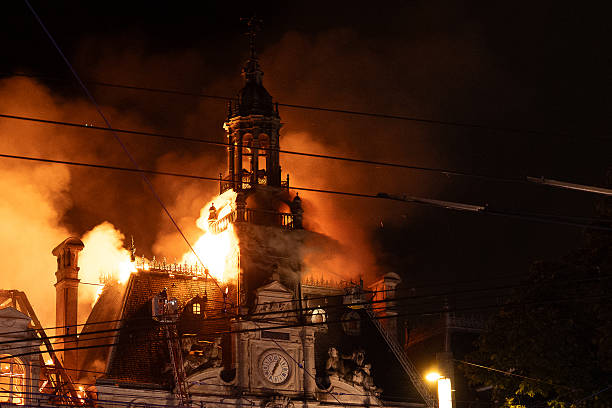
A historic town hall in Limoges, France, was gutted by fire after masked protesters broke into the building during violent unrest. Its roof and 43-metre clock tower collapsed as flames swept through the 143-year-old landmark.
A 143-year-old historic town hall in the French city of Limoges has been severely damaged after it was set ablaze during violent unrest that erupted alongside nationwide protests.
Dramatic footage from Saturday, October 17, showed flames engulfing the city's ornate Hôtel de Ville before the building's roof and central clock tower collapsed. The landmark, which was inaugurated in 1883, had survived two World Wars and was regarded as one of Limoges' most important historic buildings.
The destruction occurred as demonstrations over rising living costs and deteriorating public services spread across France. While hundreds of thousands of people took part in demonstrations, authorities said violence broke out in several cities, with groups attacking police, looting businesses and setting public buildings and vehicles on fire.
The Limoges town hall became one of the most visible symbols of the unrest after its historic tower collapsed in the middle of the blaze.
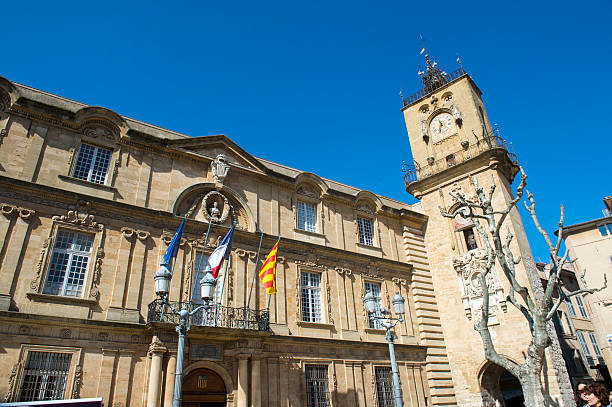
Flames engulf historic Limoges landmark
The Limoges Hôtel de Ville is a 19th-century neo-Renaissance building whose construction began in 1879. It was officially inaugurated on July 14, 1883.
Its central belfry and clock tower reached approximately 43 metres above the ground and formed one of the defining features of the building's exterior.
On the evening of October 17, however, the landmark was engulfed in flames.
According to the Haute-Vienne prefecture, rioters broke into the building at around 6 p.m. before setting it alight. Firefighters were mobilised in large numbers, but the fire spread rapidly through the building and roof.
The roof eventually collapsed, taking the clock tower with it.
The prefecture later said the destruction was extensive, with the roof falling onto lower floors and approximately two-thirds of the building's exterior disappearing.
Images and videos of the tower collapsing as the flames continued to burn quickly became a defining image of the unrest.
Building had survived two World Wars
The destruction has been particularly painful for residents because of the building's history.
The neo-Renaissance town hall had stood through major periods of French history, including both World Wars.
Reuters reported that the building had survived the conflicts without being destroyed and had become closely associated with Limoges' history and civic identity.
Limoges Mayor Guillaume Guérin described the town hall as an architectural gem and a symbol of the city.
He said the building was connected to important chapters in the city's history, including the development of its porcelain industry and the history of the CGT trade union.
The mayor also said the building's destruction represented a major loss for the city.
The scale of the damage immediately raised questions about whether the landmark could be fully restored or would require a much more extensive reconstruction.
Violence erupted during nationwide protests
The fire occurred against the backdrop of large demonstrations taking place across France.
The protests were driven by anger over the cost of living and concerns about public services, particularly education. Hundreds of thousands of people participated in demonstrations across the country.
France's Interior Ministry estimated that approximately 550,000 people participated nationwide, including about 110,000 in Paris.
Most demonstrations were peaceful.
However, violence broke out in several cities as groups clashed with police and targeted businesses and public property.
Authorities reported incidents involving fires, looting, vandalism and attacks on police officers and vehicles. Paris, Marseille, Lyon, Bordeaux and Limoges were among the cities affected.
In Limoges, the violence eventually reached the town hall.
The distinction between the wider demonstrations and the violent incidents is significant. The destruction of the town hall was attributed to a violent group, rather than to the hundreds of thousands of people who participated peacefully in the nationwide protests.
Mayor condemns attack
Guillaume Guérin strongly condemned the attack on the building.
The mayor said protesting was a democratic right and that public anger could be expressed, but argued that destroying public property could not be justified.
He described the violence as unacceptable and called for the government to provide the resources necessary to restore the building and protect the city.
In comments carried by Reuters, Guérin said national police had fought with determination but lacked sufficient resources to contain the violence.
He argued that the authorities needed to provide a concrete plan and substantial funding for Limoges following the destruction.
The mayor later called for a reconstruction effort comparable to the response to the 2019 Notre-Dame Cathedral fire in Paris.
That comparison reflects both the symbolic importance of the Limoges building and the enormous challenge facing the city.
France draws comparisons with Notre-Dame
The collapse of the Limoges tower inevitably brought back memories of the devastating fire at Notre-Dame de Paris in April 2019.
During that incident, the roof and spire of the famous cathedral were destroyed in a fire that shocked France and attracted worldwide attention.
The Limoges town hall fire was different in origin and scale, but images of its tower collapsing through flames produced a similar sense of cultural loss. Reuters reported that residents were reminded of the Notre-Dame disaster as they watched their historic civic landmark burn.
The comparison has also become part of the debate over how the Limoges building should be restored.
Guérin has called for the government to provide a reconstruction programme that would give the city the financial capacity needed to rebuild the landmark.
Investigation launched into suspected arson
French authorities opened an investigation into the fire.
By October 20, security forces had arrested a man believed to be connected to the burning of the town hall.
Euronews reported that the man, believed to be about 40 years old, was arrested by the specialised RAID police unit in the nearby town of Val d'Issoire. The Limoges prosecutor's office confirmed the arrest.
A source close to the case said the suspect had previously been flagged for surveillance because of alleged links to ultra-left movements.
Anti-terrorism police were also called in to investigate the suspected arson.
The investigation remains ongoing, and allegations against any individual should not be treated as proof of guilt unless established through the judicial process.
Authorities are also examining whether the fire was carried out by a single person or as part of a wider organised action.
The circumstances surrounding the attack have increased pressure on French authorities to identify those responsible for the destruction.
Police faced violence across France
The Limoges incident was only one part of a much wider security challenge facing French authorities.
During the protests, police officers came under attack in multiple cities.
In Limoges, the Haute-Vienne prefecture said around 2,000 people had gathered in the Casseaux area, including more than 500 people it described as deliberately seeking confrontation.
Some participants attacked security forces with projectiles, while four police officers suffered more serious injuries and four police vehicles were destroyed, according to the prefecture.
The crowd later moved toward the A20 motorway before heading into the city centre.
Businesses in the Rue Jean Jaurès area were also looted, according to authorities. Nineteen people had been detained in the region in connection with the unrest at the time of the Euronews report.
Nationally, the number of arrests rose sharply as the violence spread.
Reuters reported that nearly 1,800 people had been arrested following the unrest, while more than 500 police officers had been injured.
Subsequent reporting put the number of arrests even higher as authorities continued operations against people suspected of involvement in the violence.
Historic building now faces uncertain future
The immediate priority after the fire has been to secure the damaged structure and assess the extent of the destruction.
The collapse of the roof and tower means the building will require extensive structural assessment before reconstruction work can begin.
Officials will also have to determine which parts of the historic structure can be preserved and which sections must be rebuilt.
The challenge is particularly complicated because the town hall is not simply an ordinary government building. Its architecture, age and historical significance make preservation an important consideration.
The mayor has already indicated that rebuilding will require substantial government assistance.
The extent of the damage means restoration could take years rather than months.
A symbol of France's latest unrest
The Limoges town hall has become one of the clearest symbols of the latest wave of unrest in France.
The demonstrations themselves reflected widespread public concerns over living costs, public services and economic conditions. But the destruction of historic buildings has shifted part of the national conversation toward the consequences of violent protest.
President Emmanuel Macron condemned the attacks on public buildings and said those responsible for vandalism, attacks and looting would face prosecution.
The government has also faced questions over whether police resources were sufficient to deal with simultaneous unrest across multiple cities.
For Limoges, however, the immediate concern is more personal and local: a building that had stood for 143 years is now severely damaged.
Reconstruction could become a national issue
The town hall's destruction has already prompted calls for a national reconstruction effort.
The mayor has asked the central government to treat the rebuilding of Limoges' civic landmark with the same seriousness given to other nationally significant heritage sites.
The building's history, including its survival through two World Wars, makes its destruction particularly significant to residents.
Whether the original architectural details can be fully recreated remains a question for heritage experts and structural engineers.
For now, the remains of the Hôtel de Ville stand as a stark reminder of the violence that accompanied France's October protests.
The building was inaugurated in 1883 and survived more than a century of political, social and economic change. On October 17, 2026, it was engulfed by fire during a night of unrest, leaving its roof destroyed and its 43-metre clock tower collapsed.
As investigators work to establish who was responsible for the suspected arson and authorities assess the cost of rebuilding, the future of the historic Limoges landmark remains uncertain.
What is clear is that the city has lost a major piece of its architectural heritage — and the images of its bell tower falling through flames are likely to remain among the defining images of France's latest period of unrest.