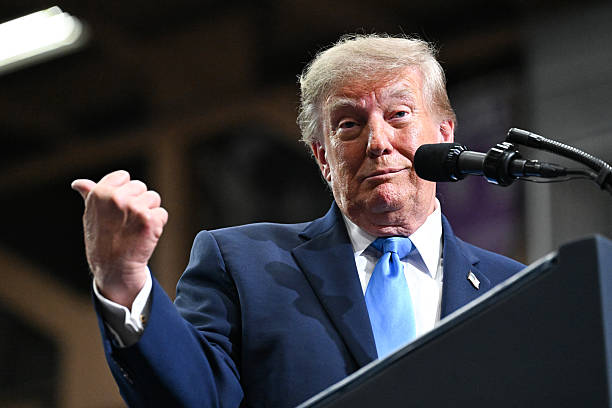
U.S. President Donald Trump has escalated his campaign to rename artificial intelligence, saying people who continue using the term “Artificial Intelligence” instead of his preferred “Super Intelligence” should be considered “THE ENEMY.”
Trump made the statement Thursday, October 8, in a post on Truth Social, claiming that the White House considers anyone using the traditional term to be an opponent.
“The White House considers anyone that uses the term, ‘Artificial Intelligence,’ as opposed to the highly accepted new and more accurate term, ‘Super Intelligence,’ THE ENEMY!”
Trump did not specify what consequences, if any, would apply to people or organizations that continue using “Artificial Intelligence.”
Trump Has Already Ordered the Federal Government to Use “Super Intelligence”
The latest statement follows an executive order Trump signed on September 29 directing federal agencies to replace “Artificial Intelligence” and “AI” with “Super Intelligence” and “SI” in official government communications.
The order applies to official correspondence, public communications, websites, reports, policy documents and other non-statutory documents across the executive branch.
The order also uses the existing federal statutory definition of artificial intelligence for its definition of “Super Intelligence” while directing the administration to develop a new federal definition.
Trump has argued that “Artificial Intelligence” is an inaccurate description because modern systems are capable of doing much more than simply imitating or automating aspects of human intelligence. The White House says the new terminology is intended to reflect the technology's expanding capabilities.
“Superintelligence” Already Has a Different Meaning in AI
The terminology change has attracted attention because “superintelligence” already has an established meaning in the technology and academic communities.
In AI research, superintelligence generally refers to a hypothetical form of artificial intelligence that would surpass human cognitive abilities across virtually all intellectual fields.
That is different from the broad category of AI systems currently available, including general-purpose systems such as ChatGPT.
PolitiFact reported that experts generally distinguish superintelligence from today's AI systems, with superintelligence referring to capabilities beyond human performance across a very broad range of tasks.
As a result, Trump's use of “Super Intelligence” as a replacement for the broader term “Artificial Intelligence” represents a change in terminology rather than the creation of an entirely new category of technology.
AI Companies Still Use the Traditional Term
Despite Trump's push, major technology companies have not generally abandoned the term AI.
OpenAI and Anthropic continue to use “artificial intelligence” publicly, while other technology companies have adopted some of Trump's preferred terminology in specific contexts.
During a White House gathering of technology executives in September, Nvidia CEO Jensen Huang used “AI” before correcting himself to “SI.”
OpenAI President Greg Brockman, meanwhile, continued to refer to the technology as artificial intelligence during remarks at the White House.
Trump's executive order applies to the federal government, rather than imposing a general legal requirement on private companies to change their terminology.
White House Websites Face an Awkward Contradiction
The administration's own digital infrastructure has also highlighted the difficulty of making the terminology change universal.
According to Axios, the White House updated its AI.gov website to prominently display “SI.gov”, although the actual web address remains AI.gov and the SI.gov address reportedly leads to an error page.
The Office of Science and Technology Policy website has also continued to use the term “artificial intelligence.”
The contradiction illustrates the gap between Trump's preferred terminology and the terminology already embedded throughout government websites, laws, regulations and the technology industry.
Trump Says the U.S. Must Lead the Technology Race
Trump's terminology campaign is part of a broader effort by his administration to position the United States as the global leader in advanced AI development.
The White House has repeatedly emphasized competition with China and the economic and national-security importance of maintaining U.S. leadership.
Trump's September executive order described the technology as a major technological frontier and said the United States should maximize its economic and scientific opportunities.
The administration has also established a Super Intelligence Task Force to help shape U.S. policy toward rapidly advancing AI technologies. Its leaders were scheduled to meet Thursday as the government develops a framework for the initiative.
For now, however, the traditional term Artificial Intelligence remains widely used by the technology industry, researchers and the public, even as Trump continues pushing “Super Intelligence” as the preferred government terminology.