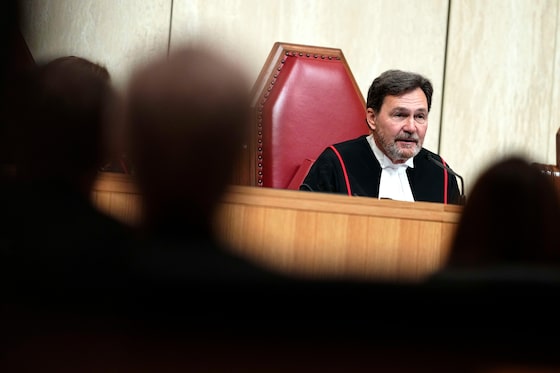
Canada’s Chief Justice Richard Wagner has warned that the country’s democratic institutions need continued protection as polarization deepens, events move at an increasingly rapid pace and artificial intelligence transforms society.
Wagner made the remarks on Monday, October 5, as the Supreme Court of Canada formally opened its new judicial year at its temporary location in Ottawa.
The Chief Justice said the pressures facing democratic institutions are “unrelenting,” pointing to a world that feels increasingly uncertain and divided.
Wagner compares democracy to an anchor
In his address, Wagner used the image of an anchor to describe the role democratic institutions play during periods of uncertainty.
“When the seas grow rough, an anchor keeps us from drifting,” he said, arguing that democratic institutions serve a similar purpose in society.
He added that the strength of an anchor is not measured during calm conditions but during a storm, drawing a direct comparison with the rule of law.
According to Wagner, the rule of law provides a stable framework for resolving disagreements peacefully and ensures that decisions are made fairly and impartially.
He urged Canadians not to lose sight of those principles even as the country and the wider world confront increasingly complex challenges.
Polarization and artificial intelligence
Wagner identified several pressures contributing to the current uncertainty.
Among them are deepening political and social polarization, the rapid pace at which events unfold and the emergence of artificial intelligence.
He said AI is transforming both people's lives and the legal world faster than many could have anticipated.
The Chief Justice also stressed that democratic institutions must adapt without abandoning the principles that underpin Canada's justice system.
Wagner said Canadians should acknowledge these challenges while maintaining confidence in the country's institutions.
Supreme Court begins a new chapter
The remarks came during a significant transition for the Supreme Court itself.
The court has moved into the West Memorial Building near Parliament Hill while its historic permanent building undergoes extensive renovations.
The refurbishment is expected to take at least 10 years. The temporary courtroom was formally inaugurated during Monday's ceremony, with the court's flag raised outside the building for the first time.
Wagner said the change of building does not alter the court's fundamental purpose.
The Supreme Court's nine judges are expected to hear more than 60 appeals during the current session, a level of activity not seen since before the COVID-19 pandemic.
The ceremony also included Justice Minister and Attorney General Sean Fraser and representatives of Canada's legal community.
Justice Minister highlights role of courts
Fraser also spoke about the importance of Canada's legal institutions at a time when distinguishing truth from falsehood can be increasingly difficult.
He pointed specifically to the rise and deployment of artificial intelligence and said the courts' role in seeking and establishing truth is particularly important in such an environment.
Fraser also referred to Canada's legal tradition of the “living tree” doctrine, saying the country's laws must be capable of addressing changing realities while maintaining strong foundations.
Wagner calls for collective responsibility
The Chief Justice emphasized that protecting democracy is not solely the responsibility of courts.
He pointed to public discussions, awareness campaigns, articles, opinion pieces and town halls across Canada as examples of efforts to strengthen understanding of democratic institutions.
Wagner said the responsibility ultimately belongs to everyone.
He also referenced a recent Quebec gathering involving more than 700 people from different parts of society who discussed ways to protect the rule of law.
As the Supreme Court begins its new judicial year in a temporary home, Wagner's message was that institutional stability becomes particularly important when society is facing uncertainty, polarization and rapid technological change.