Scotland’s first dedicated AI literacy teacher has warned pupils not to blindly trust artificial intelligence, saying young people must learn to question and verify information produced by the technology.
Jamie Laycock, a former principal teacher of biology, has taken up the new role at Mearns Castle High School in East Renfrewshire, which is believed to be the first school in the UK to appoint a dedicated principal teacher focused specifically on AI literacy.
Teaching pupils to question AI
Laycock's role is not to encourage pupils to use AI for everything, but to help them understand both its benefits and its limitations.
One of his key messages is simple: AI can be wrong, even when it sounds completely confident.
In lessons, pupils are introduced to the concept of AI “hallucinations” — situations where an AI system generates information that is inaccurate or completely made up.
Laycock said young people without sufficient foundational knowledge may struggle to distinguish an AI-generated falsehood from a genuine fact.
His approach is therefore to encourage pupils to question AI responses and independently verify important information.
The warning comes as AI tools become increasingly common among students for homework, revision and coursework.
Pupils tested on AI-generated images
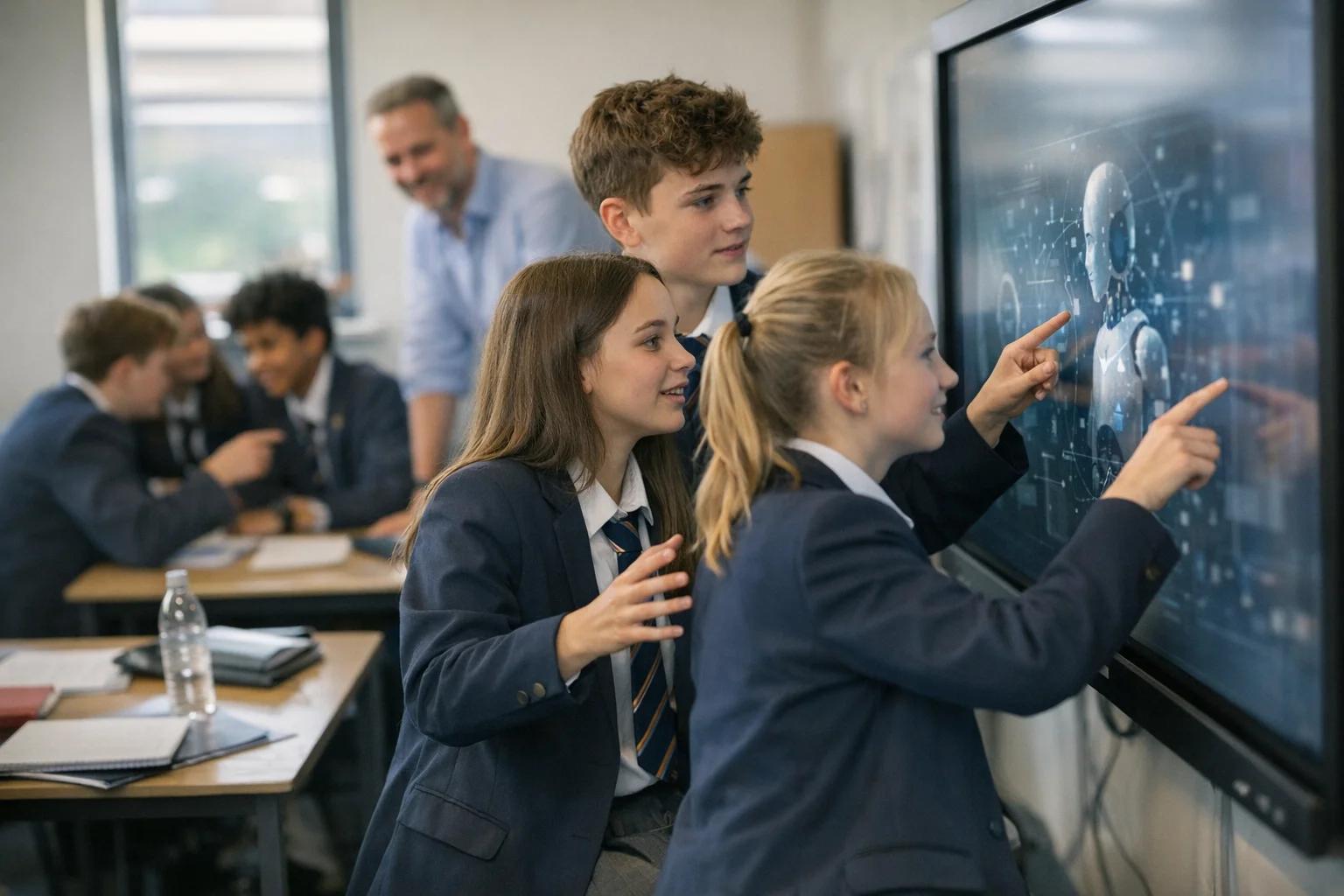
One of Laycock's early lessons involved showing students a mixture of genuine and AI-generated images and asking them to identify which were fake.
The exercise proved more difficult than some pupils expected, highlighting how rapidly AI-generated images and deepfakes are improving.
One student, Anna, said the exercise left her less confident about her ability to distinguish real images from fake ones.
For Laycock, that uncertainty is precisely why AI literacy needs to become part of education.
Rather than assuming students will naturally understand the technology, schools need to give them the skills to critically assess what they encounter online.
AI can sound human without being human
Another issue Laycock wants pupils to understand is the tendency to treat AI systems as if they were people.
Because chatbots communicate in a natural, conversational way, users can easily begin treating them like trusted friends, advisers or experts.
Laycock warns that this can be particularly difficult for young people to recognise.
He also says AI systems can be overly agreeable and flattering, potentially encouraging users to accept their own ideas without enough critical examination.
His message is that pupils need to remember that, regardless of how human-like an AI system sounds, it remains a machine.
Pupils urged not to become dependent on AI
The school is also addressing the risk of over-reliance.
Laycock wants students to understand that AI should support their learning rather than replace their own thinking.
One pupil, Aydin, said AI should be used as a tool to help students understand how to reach an answer rather than simply providing the answer for them.
That distinction is becoming increasingly important as generative AI becomes capable of producing essays, solving problems, creating images and answering complex questions within seconds.
The concern is that students who consistently allow AI to do their thinking could fail to develop the underlying knowledge and critical-thinking skills they need.
Scotland expands AI guidance in schools
The new role at Mearns Castle comes as Scotland develops a broader approach to AI in education.
The Scottish Government published national guidance on AI in schools in March 2026, stressing that artificial intelligence should enhance rather than replace human relationships and teaching.
The guidance says pupils should use AI to support creativity, critical thinking and personalised learning while their privacy and rights are protected.
Education Scotland also warns that AI-generated material can be inaccurate or misleading and that excessive reliance on AI can limit the development of critical-thinking and problem-solving abilities.
It recommends that pupils be taught how AI works, how to construct effective prompts and how to evaluate AI-generated responses rather than accepting them at face value.
AI lessons across the school
At Mearns Castle High School, pupils in S1 and S2 are expected to receive dedicated AI literacy lessons, while older students will encounter the subject through citizenship and personal education classes.
An elective course will also be available to senior pupils.
Laycock will additionally help train other teachers and develop educational materials that could potentially be used beyond the school.
The initiative has attracted interest from both parents and pupils who are increasingly asking how AI will affect education, employment and future careers.
Some senior pupils have volunteered to work with Laycock on developing ways to teach AI literacy to other students.
Preparing students for an AI-driven future
The school’s head teacher, Stuart Clark, said the implications of artificial intelligence for the economy and wider society could be profound.
But he stressed that introducing AI education should not be confused with promoting the technology.
The objective is to ensure students understand both the opportunities and risks before becoming heavily dependent on it.
For Laycock, the central lesson is not that pupils should avoid AI altogether.
Instead, they need to understand when it can help, when it can mislead them and when they need to rely on their own knowledge and judgment.
As AI becomes increasingly embedded in education and everyday life, Scotland's experiment at Mearns Castle reflects a growing shift in schools: rather than pretending the technology does not exist, educators are beginning to teach young people how to use it without surrendering their ability to think for themselves.