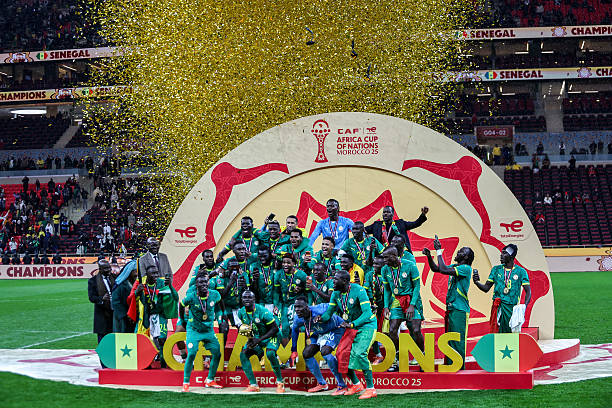
Senegal have officially been reinstated as winners of the 2025 Africa Cup of Nations after the Court of Arbitration for Sport (CAS) overturned the Confederation of African Football's decision to strip them of the trophy and award Morocco a 3-0 victory.
The landmark ruling was announced on Tuesday, November 24, 2026, following an appeal by the Senegalese Football Federation (FSF) against CAF and the Royal Moroccan Football Federation.
CAS upheld Senegal's appeal unanimously, confirming that the original 1-0 victory over Morocco in the January 18 final stands. The decision brings an end to months of uncertainty surrounding one of the most controversial matches in African football history, although Morocco has indicated that it intends to pursue further legal options. TAS CAS
CAS overturns CAF's decision to award Morocco the trophy
The dispute began after CAF's Appeal Board ruled on March 17, 2026, that Senegal had forfeited the AFCON final because their players temporarily left the pitch in protest against a late penalty awarded to Morocco.
CAF applied Articles 82 and 84 of its Africa Cup of Nations regulations, which deal with teams refusing to play or leaving the field without the referee's authorisation.
The Appeal Board consequently declared Senegal the losers and recorded a 3-0 victory for Morocco, effectively stripping the Senegalese team of the championship they had originally won on the pitch.
Senegal rejected the decision and took the matter to CAS, football's highest independent sports arbitration body.
In its November 24 ruling, CAS set aside the CAF Appeal Board's decision and reinstated the earlier decision of CAF's Disciplinary Board. It also confirmed that the result recorded at the end of the final was a 1-0 victory for Senegal.
The ruling means Senegal retain the AFCON 2025 title, while Morocco lose the championship previously awarded to them by CAF. TAS CAS
Why CAS ruled in Senegal's favour
A central issue in the legal dispute was whether the referee had the authority to restart the match after Senegal's players temporarily walked off the pitch.
The Senegalese Football Federation argued that referee Jean-Jacques Ngambo Ndala's decision to resume the match and allow it to reach a sporting conclusion was protected by football's established principle that refereeing decisions concerning events on the pitch should generally not be overturned by disciplinary authorities.
Morocco, meanwhile, argued that Senegal's actions breached the AFCON regulations and that the referee should have ended the match rather than allowing play to continue.
CAS examined the circumstances surrounding the walk-off, the referee's decision and the competition regulations.
The panel concluded that the referee had not committed an error of law when he restarted the match. It also found that Articles 82 and 84, which CAF's Appeal Board had relied upon, applied to circumstances in which a referee permanently abandons a match.
In this case, the referee had resumed play, both teams returned to the field and the final was completed.
CAS therefore determined that the original sporting result had to stand.
The court's decision was unanimous, providing Senegal with the legal outcome they had sought since CAF overturned the result in March. TAS CAS
How the controversial AFCON final unfolded
The final between Senegal and hosts Morocco took place on January 18, 2026, at the Prince Moulay Abdellah Stadium in Rabat.
It was an intense contest between two of Africa's leading national teams, with both sides struggling to find a breakthrough during normal time.
The controversy escalated in stoppage time when Senegal believed they had scored, only for the referee to disallow the goal following a foul decision.
Moments later, Morocco were awarded a penalty after a VAR review of an incident involving Senegal defender El Hadji Malick Diouf and Morocco forward Brahim Diaz.
The penalty decision sparked furious protests from Senegal's players and coaching staff.
Head coach Pape Thiaw led the Senegalese players away from the pitch, bringing the match to a halt for approximately 14 minutes.
The situation threatened to end the final in extraordinary circumstances, with the Senegalese delegation refusing to accept the penalty decision.
However, captain Sadio Mané played an important role in persuading his teammates to return and continue the match.
When play resumed, Diaz stepped forward to take the penalty, but his attempted Panenka was saved by Senegal goalkeeper Édouard Mendy.
The missed opportunity proved decisive.
The match proceeded into extra time, where midfielder Pape Gueye scored the winning goal in the 94th minute to give Senegal a 1-0 victory.
Senegal celebrated their second Africa Cup of Nations title, but the celebrations were followed by an unprecedented legal battle that eventually saw CAF award the championship to Morocco before CAS reversed that decision. Sky Sports
Morocco react angrily and consider further legal action
Morocco's football federation has expressed strong disagreement with the CAS verdict.
The Royal Moroccan Football Federation said it was astonished by the decision and confirmed its intention to pursue all available legal procedures to challenge the ruling.
The federation had maintained that Senegal's temporary withdrawal from the pitch constituted a breach of the competition regulations and should have resulted in a forfeiture.
Morocco had also challenged aspects of the CAS proceedings, including concerns about the composition of the arbitration panel and allegations involving contact between a panel member and the Senegalese football federation's president.
CAS received a challenge petition shortly before announcing its decision but determined that there were insufficient grounds at that stage to postpone notification of the verdict.
Although Morocco has indicated that it wants to continue the legal process, challenging a CAS award at Switzerland's Federal Supreme Court is permitted only on limited procedural grounds. It is not a general opportunity to have the sporting dispute reconsidered from the beginning. Sky Sports
Senegal retain their second AFCON championship
For Senegal, the decision restores the title they originally celebrated after defeating Morocco in Rabat.
The Lions of Teranga had previously won the Africa Cup of Nations for the first time in 2021, when they defeated Egypt on penalties in the final held in Cameroon in February 2022.
Their 2025 triumph was supposed to represent another major achievement for a generation that has established Senegal as one of the continent's leading football nations.
Instead, the team spent months dealing with uncertainty after CAF's decision to reverse the final result.
The CAS verdict now confirms Senegal as champions and restores the significance of the victory secured through Pape Gueye's extra-time strike.
It also means Morocco's hopes of celebrating a second AFCON title following their 1976 triumph have been postponed.
The decision will remain an important reference point in discussions about the relationship between refereeing authority, competition regulations and disciplinary decisions in international football. Reuters
What happens next after the CAS verdict?
Although CAS has delivered its decision, the dispute may not be entirely over.
Morocco's football federation has announced plans to pursue available legal procedures, leaving open the possibility of a further challenge on the limited grounds permitted under Swiss law.
However, unless the ruling is successfully challenged through the appropriate legal process, the official sporting result remains Senegal's 1-0 victory.
The decision also reinforces the importance of the referee's authority during a football match, particularly when determining whether play should continue or be abandoned.
For CAF, the case represents a major institutional challenge. Its original decision to award Morocco the trophy has now been overturned by the international sports arbitration body.
For Senegal, however, the immediate outcome is clear: the country has been restored as the winner of the 2025 Africa Cup of Nations.
After months of controversy, appeals and legal arguments, the trophy belongs to the team that won the final on the pitch.
Senegal are AFCON 2025 champions once again.