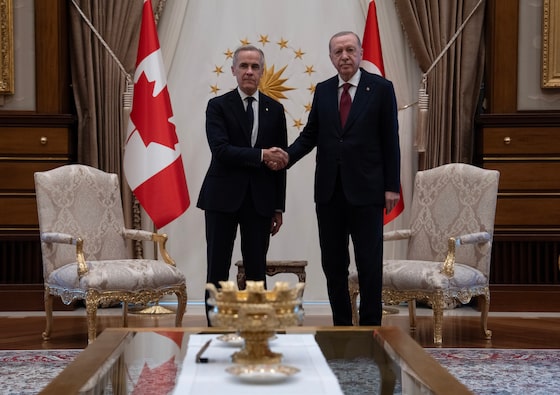
Canada and Turkey have launched a new strategic partnership aimed at expanding cooperation in trade, investment, defence, energy and people-to-people relations, as the two countries seek to strengthen economic and security ties amid a changing global environment.
The partnership was announced by Canadian Prime Minister Mark Carney and Turkish President Recep Tayyip Erdoğan following Carney’s visit to Türkiye, the first bilateral visit by a Canadian prime minister to the country. The agreement is backed by a three-year action plan built around four main areas: trade and investment, defence and security, energy and climate cooperation, and government-to-government and people-to-people ties.
The agreement marks an expansion of relations between the two NATO allies, which have maintained diplomatic relations since 1944.
Canada and Turkey Target New Trade Opportunities
Trade and investment are central to the new partnership, with both governments agreeing to work toward a comprehensive Canada-Türkiye Free Trade Agreement.
The first round of formal negotiations is scheduled to take place in Ankara from November 30 to December 4, 2026.
Canada said two-way merchandise trade with Türkiye reached $4.3 billion in 2025, consisting of about $1.1 billion in Canadian exports and $3.2 billion in imports from Türkiye. The Canadian government said bilateral trade has grown by almost 50 per cent since 2020, although it believes the relationship still has considerable room for expansion.
The two countries also intend to increase cooperation in priority sectors including energy, defence production, aerospace and artificial intelligence.
As part of the effort to encourage companies from both countries to work together internationally, Export Development Canada and Türk Eximbank signed a memorandum of understanding covering cooperation on projects in third countries.
The arrangement could allow Canadian and Turkish companies to collaborate on projects in international markets and pursue opportunities beyond their respective domestic economies.
Canada also announced plans for a trade mission to Türkiye in 2027, led by the Canadian Minister of International Trade.
Energy Cooperation Takes Centre Stage
Energy is another major component of the partnership, with Canada and Türkiye signing a separate joint statement designed to expand cooperation across several areas of the energy and natural-resources sector.
The agreement covers liquefied natural gas (LNG), civil nuclear energy, renewable energy, clean technologies and critical minerals.
Canadian Energy and Natural Resources Minister Tim Hodgson and Türkiye's Energy and Natural Resources Minister Alparslan Bayraktar signed the joint statement in Ankara on October 22.
The two governments said they want to strengthen energy security, diversify supply chains and encourage investment in energy and natural-resource projects.
Canada is particularly interested in using its growing LNG export capacity to expand its role in global energy markets.
Under the agreement, Canadian LNG project developers and potential Turkish long-term buyers will be encouraged to hold further discussions about possible procurement arrangements.
The Canadian government said such arrangements could help Türkiye diversify its energy supplies while supporting Canada's position as an LNG supplier.
Nuclear Energy Cooperation
Civil nuclear energy is also emerging as an important area of cooperation.
Canadian and Turkish officials discussed Canada's potential involvement in Türkiye's New Nuclear Project, with Canada highlighting its nuclear technology, operating experience and domestic supply chain.
The two sides agreed to encourage further discussions involving governments, regulators, research institutions, technical organizations and private companies.
Canadian officials said nuclear cooperation could contribute to Türkiye's energy security while creating opportunities for Canadian companies and technology providers.
The energy agreement also covers renewable power, carbon capture and storage, geothermal technology and clean-energy investment.
Canada and Türkiye said they would explore opportunities for cooperation on next-generation geothermal systems, including advanced closed-loop geothermal technologies.
Critical Minerals and Mining
Critical minerals are another priority under the partnership.
The countries plan to encourage bilateral investment and trade throughout the mining value chain, including exploration, drilling, laboratory analysis, resource modelling and reporting.
The cooperation is expected to include battery minerals and technologies, areas that have become increasingly important as countries attempt to strengthen supply chains for clean-energy technologies and reduce vulnerabilities associated with concentrated sources of critical minerals.
Türkiye has also adopted the Mining Association of Canada's Towards Sustainable Mining standards, according to the Canadian government.
The two countries intend to encourage cooperation between their geological and mining institutions, including Canada's Geological Survey and Türkiye's General Directorate of Mineral Research and Exploration.
Defence and Security Cooperation
Defence cooperation forms another major pillar of the strategic partnership.
As NATO members, Canada and Türkiye already cooperate through the alliance, but the new agreement seeks to deepen bilateral defence-industry links.
Canada and Türkiye welcomed the conclusion of a Defence Sector Partnerships Memorandum of Understanding between Global Affairs Canada and Türkiye's Presidency of Defence Industries.
The agreement is designed to help Canadian and Turkish defence companies establish partnerships and pursue joint opportunities.
The two governments also intend to build on a Statement of Intent on Defence Cooperation signed earlier in 2026.
That framework provides for expanded cooperation in areas including military-to-military dialogue, operational support and defence-industrial collaboration.
The strategic partnership also identifies Ukraine, the South Caucasus and the Middle East as areas where the two countries intend to strengthen cooperation in support of regional and international security.
The leaders specifically highlighted Gaza as part of their discussions on the Middle East.
They also agreed to begin dialogue aimed at strengthening cooperation on mutual legal assistance in criminal matters and extradition.
Partnership Comes Amid Changing Global Trade and Security Environment
The agreement comes at a time when Canada is seeking to diversify its economic and strategic partnerships.
Carney's government has emphasized building stronger relationships with countries and regions beyond Canada's traditional economic dependence on the United States.
Türkiye offers Canada access to a market of more than 85 million people and a geographical position connecting Europe, Asia and the Middle East.
The Canadian government also highlighted Türkiye's membership of NATO and the G20, as well as its extensive network of free-trade agreements.
The strategic partnership therefore gives both countries an opportunity to expand their cooperation beyond traditional bilateral trade.
For Türkiye, deeper economic and energy links with Canada could provide additional sources of investment, technology and energy supplies.
For Canada, Türkiye offers another market for Canadian energy, mining, aerospace and defence companies and a potential gateway to wider markets in Europe, Asia and the Middle East.
Expanded Air Links to Boost Business and Travel
The partnership also includes measures aimed at strengthening connections between people and businesses.
Canada and Türkiye have expanded their Air Transport Agreement, increasing the number of weekly passenger flights from 12 to up to 21, while allowing unlimited cargo flights between Canadian and Turkish airports.
The governments said the expanded agreement would make travel easier for families, students and tourists while creating additional opportunities for exporters.
Unlimited cargo access could also support trade by making it easier for businesses to move goods between the two markets.
The strategic partnership further calls for closer cooperation on migration, consular matters, mobility, cultural exchanges and diaspora engagement.
The countries also plan to establish an annual Canada-Türkiye Strategic Dialogue and continue annual Joint Economic and Trade Committee meetings.
Political-military and counter-terrorism consultations will also continue under the new framework.
A Three-Year Roadmap
Rather than being limited to a single agreement, the new partnership provides a three-year framework for expanding cooperation.
The four pillars are:
1. Trade, investment and innovation
2. Energy and climate cooperation
3. Defence and security
4. Government-to-government and people-to-people ties
The leaders agreed that their foreign ministers would oversee implementation of the action plan.
The framework is intended to translate the political agreement into specific areas of cooperation, including trade negotiations, energy projects, defence-industry partnerships and increased institutional dialogue.
Carney described Türkiye as an important partner for Canada as it works to diversify trade and strengthen economic and security relationships.
The Canadian government said the partnership is intended to open new markets for Canadian companies, strengthen defence industries and improve energy security.
For Türkiye, the agreement provides a new avenue for cooperation with a major G7 and NATO economy, particularly in energy technology, LNG, nuclear power, critical minerals and defence.
The first major test of the economic side of the agreement will come with the launch of formal free-trade negotiations at the end of November.
If negotiations progress, a comprehensive Canada-Türkiye trade agreement could provide a broader framework for investment and market access between the two economies.
For now, the strategic partnership establishes the political framework for that deeper relationship, while the three-year action plan sets out the areas in which Canada and Türkiye intend to turn the agreement into concrete cooperation.