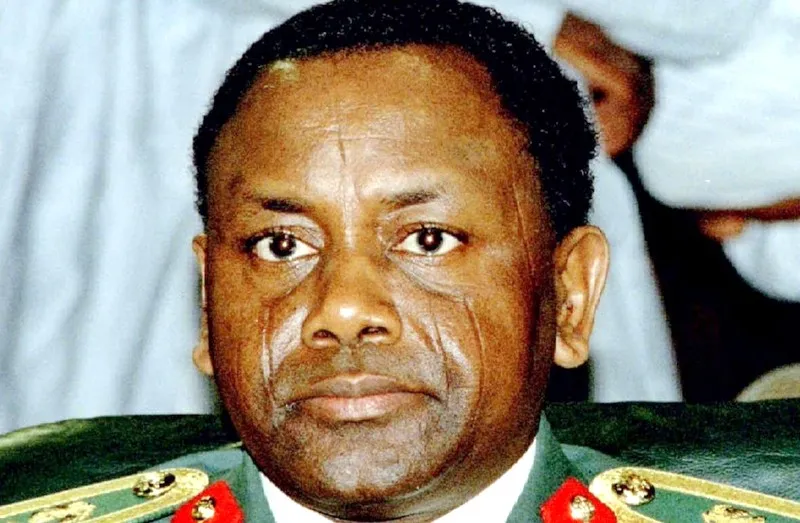
KADUNA — Major Hamza Al-Mustapha (retd.), the former Chief Security Officer (CSO) to Nigeria's late military Head of State, General Sani Abacha, has forcefully rejected a newly published account detailing the circumstances surrounding the ruler’s sudden death in June 1998.
Speaking to journalists on the sidelines of the 3rd General Hassan Usman Katsina Memorial Conference at Arewa House in Kaduna, Al-Mustapha dismissed claims made by Dennis Amachree, a retired Assistant Director of the Department of State Services (DSS), characterising them as complete fabrications.
The sharp rebuke comes in response to Amachree’s recently published memoir, The Shadow Warrior, which offers a detailed, first-hand intelligence narrative of the events that transpired inside the Aso Rock Presidential Villa in Abuja on June 8, 1998. The publication has reignited intense public debate surrounding one of the most shrouded, politically sensitive episodes in Nigeria’s modern history.
Rejecting the assertions in the memoir, Al-Mustapha claimed that the account was orchestrated by third parties to mislead the public, asserting that he holds definitive technical evidence that directly contradicts the author's narrative.
"The boy was asked by others to write those lies. I have all the CCTV footage of what happened in my custody, so what he said is not true," Al-Mustapha told reporters. "Just ignore his lies. It’s bad to say such things about someone who is dead and can no longer defend himself."
Despite asserting the existence of archived security recordings from the presidential villa, the former chief security officer did not elaborate on the specific details captured in the footage, nor did he indicate whether he intends to release the materials for public review or judicial archiving.
Historical Context: The Unresolved Mystery of June 8, 1998
General Sani Abacha, who assumed power following a military coup on November 17, 1993, governed Nigeria during a period of intense political friction, international isolation, and heightened internal security measures. His abrupt death at the age of 54 brought an immediate end to his regime and set in motion a rapid political transition toward democratic governance in May 1999.
At the time of his passing, the official announcement issued by the Federal Military Government stated that the Head of State had succumbed to a sudden heart attack resulting from natural causes. However, the absence of a publicly released post-mortem report fueled widespread speculation, giving rise to numerous conflicting theories over the past nearly three decades.
In the years following the transition to civilian rule, former military commanders, intelligence officers, foreign diplomats, and medical personnel have offered competing versions of the events of that night.
-
Official State Accounts: Maintained that the military leader experienced sudden cardiac arrest within the presidential residence.
-
Intelligence and Security Claims: Suggested various alternative scenarios, including allegations of targeted poisoning, political sabotage, or unverified personal encounters.
-
Medical Perspectives: Highlighted underlying health vulnerabilities that were kept strictly confidential by the presidential medical team during his tenure.
Amachree's memoir, The Shadow Warrior, represents the latest attempt by a former senior state security officer to provide an insider perspective on the operational climate, intelligence assessments, and security protocols surrounding Aso Villa during the final hours of the military administration.
The Role of Key Players: Custodians of State Secrets
Major Hamza Al-Mustapha occupied an extraordinarily powerful position within the military administration as Chief Security Officer. Responsible for the inner security perimeter of the Presidential Villa, the intelligence apparatus attached to the Head of State, and personal protection protocols, Al-Mustapha was widely recognized as one of the most influential figures in the country between 1993 and 1998.
Following Abacha’s death and the subsequent dissolution of the specialized security units, Al-Mustapha was arrested in 1999 under the transitional government. He spent over fourteen years in judicial custody facing charges related to state security operations during the military era, including high-profile political trials. He was discharged and acquitted by the Court of Appeal in 2013, after which he re-entered public life, frequently appearing at academic forums and historical symposia to defend the record of the Abacha administration.
On the other hand, Dennis Amachree served as a high-ranking intelligence operative within the Department of State Services—Nigeria's primary domestic intelligence agency—during the same era. His memoir reflects the perspective of the broader intelligence community, which often operated in tandem, and sometimes in friction, with the specialized military security detail directly commanded by Al-Mustapha.
The dispute between the two former officials underscores a long-standing structural rift between institutional intelligence services and elite presidential security units regarding the official historical record of the 1990s.
Archival Evidence and the Challenge of Historical Documentation
Historiographers, legal analysts, and political scientists studying Nigerian history note that public disputes over the Abacha era highlight a persistent challenge: the lack of accessible, declassified state archives in Nigeria.
In many constitutional democracies, official presidential records, intelligence logs, medical reports, and internal communications are declassified after a mandatory period—typically 20 to 30 years—allowing independent historians and researchers to establish an objective timeline of significant national events.
In the absence of systematic state declassification, the historical record of critical transitions in Nigeria relies heavily on personal memoirs, media interviews, and unverified eyewitness accounts. This dynamic creates an environment where conflicting narratives continue to proliferate without definitive resolution.
While Al-Mustapha’s reference to intact CCTV footage from 1998 presents a potential source of primary evidence, archival specialists emphasize that without public deposition into national archives or verified forensic review, such claims remain part of the broader ongoing debate over state secrecy and public memory.
As former officials continue to publish memoirs and present competing perspectives, the debate surrounding the final days of the Abacha administration remains a critical, albeit complex, chapter in the study of West African political history.